
What is Parallel or Flash ADC : Advantages and disadvantages
Advertisement
A Flash ADC, also called a parallel ADC, converts analog signals into digital values using multiple comparators operating simultaneously. It is the fastest type of analog to digital converter and is widely used in radar, communication, and instrumentation systems. Advantages include ultra high speed, while disadvantages include high power consumption and increased hardware complexity.
Flash ADC block diagram & Conversion Process
It converts the analog signal into its digital equivalent in a single step, making it ideal for high speed applications like oscilloscopes and radar systems.
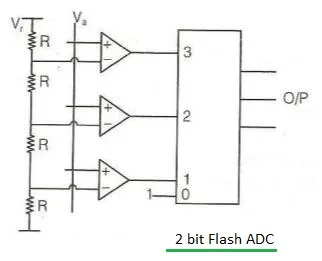
Figure : Flash Type ADC
Figure illustrates a block diagram of a parallel comparator ADC, also known as a 2-bit flash ADC. This is the fastest ADC type.
For an n-bit flash ADC, (2^n - 1) comparators and 2^n registers are required. Each comparator compares Vin to a different reference voltage, starting with Vref = 1/2 (LSB - Least Significant Bit). Op-amps are typically used as comparators here.
Advantages of Flash ADC
Following are some of the benefits of flash or parallel ADC type.
- It offers highest conversion speed.
- It offers single cycle conversion.
- It offers excellent dynamic performance at high frequencies.
Disadvantages of Parallel ADC
Following are some of the drawbacks of parallel or flash ADC.
- It has exponential increase in complexity with resolution.
- It offers very high power consumption.
- Large die area requirements.
- It offers limited practical resolution (<10 bits).
Summary
Flash ADCs deliver extremely fast analog to digital conversion for high speed applications. Advantages include rapid conversion rates, while disadvantages include high cost and power requirements.
Continue Learning Data Converter Fundamentals & Comparisons
- ADC vs DAC: Understanding the Difference
- ADC Types Comparison
- ADC Dynamic Range Explained
- DAC Types: Weighted Resistor vs R-2R Ladder
- Sample and Hold ADC: Advantages and Disadvantages
Explore ADC Architectures & Types
- SAR ADC (Successive Approximation Register): Advantages & Disadvantages
- Delta-Sigma ADC: Advantages and Disadvantages
- Pipeline ADC: Advantages and Disadvantages
- Dual Slope ADC: Advantages and Disadvantages