
What is Dual Slope ADC : Advantages and disadvantages
Advertisement
A dual slope ADC converts analog signals into digital values by integrating the input voltage over a fixed period and then measuring the discharge time. It is widely used in precision measurement instruments. Advantages include excellent noise rejection and accuracy, while disadvantages include slow conversion speed and limited suitability for high speed applications.
Introduction : A Dual Slope ADC integrates the input signal over a fixed time, then discharges at a known rate to determine the digital value. This method averages out noise and power line interference, making it highly stable and accurate.
Dual Slope ADC Block diagram
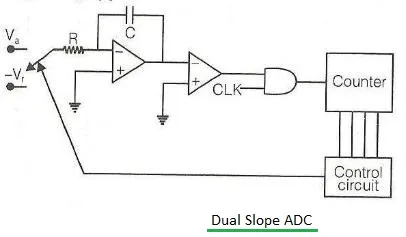
Figure : Dual Slope Integrating Type ADC
Figure illustrates a block diagram of a Dual Slope Integrating type ADC. These ADCs are often used in the design of digital voltmeters.
For an n-bit dual slope ADC, Vr = (2^n / N) * Va
The total time for conversion of input Va is expressed as: Total Time = (2^n + N) * T_CLK
Advantages of Dual Slope ADC
Following are some of the benefits of Dual Slope ADC.
- It offers high accuracy and linearity.
- It offers excellent noise rejection i.e. noise immunity.
- It is simple in implementation.
Disadvantages of Dual Slope ADC
Following are some of the drawbacks of Dual Slope ADC.
- It offers very slow conversion rate.
- It requires high quality integrator.
- It’s design is limited to DC or slowly varying signals.
Summary
Dual slope ADCs provide highly accurate analog to digital conversion. Advantages include precision and noise immunity, while disadvantages include slower conversion rates.
Continue Learning Data Converter Fundamentals & Comparisons
- ADC vs DAC: Understanding the Difference
- ADC Types Comparison
- ADC Dynamic Range Explained
- DAC Types: Weighted Resistor vs R-2R Ladder
- Sample and Hold ADC: Advantages and Disadvantages
Explore ADC Architectures & Types
- SAR ADC (Successive Approximation Register): Advantages & Disadvantages
- Delta-Sigma ADC: Advantages and Disadvantages
- Flash ADC: Advantages and Disadvantages
- Pipeline ADC: Advantages and Disadvantages