
What is FHSS : Frequency Hopping Spread Spectrum Advantages and Disadvantages
Advertisement
Frequency Hopping Spread Spectrum (FHSS) is a wireless communication technique that rapidly switches carrier frequencies according to a predefined sequence. It improves resistance to interference, jamming and eavesdropping. Advantages include enhanced security and robustness, while disadvantages include synchronization complexity and lower spectral efficiency compared to some modern techniques.
Key Features of FHSS
- FHSS stands for Frequency Hopping Spread Spectrum.
- In FHSS, the carrier frequency used for modulation is varied according to a predefined Pseudonoise Random Sequence (PRS) generator. Both the transmitter and receiver know this PN sequence.
- FHSS techniques are divided into two main types:
- Fast Hopping: The hopping rate is higher than the information rate.
- Slow Hopping: The hopping rate is slower than the information rate.
- Information bits are transmitted using different frequencies.
- FHSS offers a capacity of about 3 Mbps.
- It’s a very robust technology.
- It’s well-suited for point-to-multipoint scenarios.
FHSS Transmitter and Receiver Block Diagram
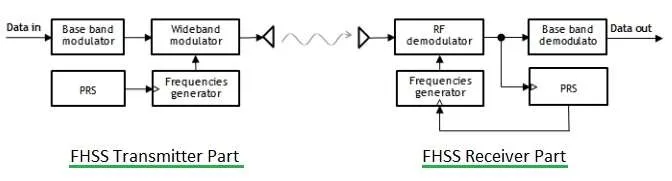
Figure 1: FHSS transmitter and FHSS receiver block diagrams.
A Frequency Hopping Spread Spectrum (FHSS) transmitter is a communication device that rapidly changes its carrier frequency among many predetermined channels according to a pseudorandom hopping sequence known to both the transmitter and receiver. This technique spreads the signal over a wide frequency band, making it more resistant to interference, jamming, and eavesdropping. The transmitter consists of a data source, frequency synthesizer generator, hopping pattern generator (or PRS), wideband modulator and RF amplifier (not shown in figure).
An FHSS receiver follows the same hopping sequence and timing as the transmitter to synchronize with the changing frequencies. It receives the hopped signal, demodulates the data, and reconstructs the original information. FHSS systems are widely used in wireless communication technologies because they provide improved security, reliability, and efficient spectrum utilization.
Benefits or Advantages of FHSS
Here are the key benefits and advantages of FHSS:
- Robust Transmission: FHSS provides a very robust transmission path, even in the presence of interference like multipath, noise, and other wireless transmissions. This is thanks to its support of a wide bandwidth.
- Point-to-Multipoint Applications: FHSS can be effectively used in point-to-multipoint setups.
- Coexistence with WLAN: It can support about ten nearby WLAN compliant Access Points (APs) without causing significant interference problems.
- Security: FHSS provides a level of security against intrusion because only the transmitter and receiver know the PN codes used for frequency hopping.
Drawbacks or Disadvantages of FHSS
Here are the main disadvantages of FHSS:
- Bursty Errors: Because FHSS relies on carrier frequencies to transmit information bits, it’s prone to strong bursty errors due to frequency selective fading.
- Lower Data Rate: It supports a lower data rate of 3 Mbps compared to the 11 Mbps offered by DSSS (Direct Sequence Spread Spectrum).
- Limited Coverage Range: FHSS requires a high Signal-to-Noise Ratio (SNR) at the receiver, which can lead to a lower coverage range.
- Obsolete Technology: The modulation scheme has become somewhat obsolete due to the emergence of newer wireless technologies in wireless products.
Summary
FHSS improves wireless communication reliability through rapid frequency changes. Advantages include interference resistance and security, while disadvantages include synchronization challenges and limited bandwidth efficiency.