
What is Electromagnetic Log : EM Log Advantages and Disadvantages
By RF Wireless Expert Team
Advertisement
An electromagnetic log (EM Log) is a marine navigation instrument that measures a vessel’s speed relative to water using electromagnetic principles. It is commonly used on ships and marine platforms for navigation and performance monitoring. Advantages include reliable operation without moving parts, while disadvantages include sensitivity to water conductivity and calibration requirements.
Electromagnetic Log working principle
- An EM Log is a device used in marine engineering to measure a ship’s speed through the water.
- It operates based on Faraday’s Law of Induction and Maxwell’s Equations.
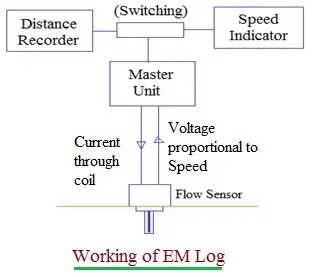
- As illustrated, current is passed through the coil of the flow sensor, creating an electromagnetic (EM) field.
- When water (a conductor) flows through this EM field, a voltage is generated.
- The magnitude of the voltage is directly proportional to the speed of the water (the conductor).
- Consequently, the EM Log measures the ship’s speed through the water by detecting this induced voltage.
Advantages of Electromagnetic Log (EM Log)
Following are the benefits of using an EM Log.
- No Moving Parts: It doesn’t have any moving components, which reduces wear and tear and the need for maintenance.
- Less Affected by Sea Growth: Compared to pit swords (another type of speed log), EM Logs are less susceptible to fouling from marine organisms.
- Modern Design: Modern sensor designs don’t protrude from the bottom of the ship, reducing drag and potential damage.
- Compact Size: Modern EM Logs are smaller, making them easier to install and integrate into ship systems.
- High Accuracy at Low Speeds: EM Logs provide more accurate speed measurements, especially at lower ship speeds.
Disadvantages of Electromagnetic Log (EM Log)
Following are the drawbacks of using an EM Log.
- Affected by Water Conditions: Water salinity and temperature can affect the calibration of the EM Log, leading to inaccurate measurements. Regular calibration is necessary to mitigate this.
- Measures Speed Relative to Water: It measures the speed of the ship relative to the surrounding water, not relative to the seabed. This is a crucial distinction in areas with strong currents.
- Influence of Boundary Layer: The boundary layer, where the water speed is reduced due to friction near the hull, can influence measurements. This slowdown of water near the hull needs to be accounted for.
Summary
EM logs measure vessel speed using electromagnetic fields and conductive seawater. Advantages include durability and accuracy, while disadvantages include dependence on water conditions and calibration complexity
Continue Learning Electromagnetic Theory, Spectrum & Waves
- Electromagnetic Spectrum Overview
- Electromagnetic Spectrum Management
- Maxwell’s Electromagnetic Equations
- Electromagnetic Energy: Advantages and Disadvantages
- Electromagnetic Wave vs Surface Acoustic Wave
Explore EMI/EMC Compatibility & Radiation Standards
- Electromagnetic Compatible System Requirements
- Electromagnetic Radiation Standards and Mitigation Techniques