
What is DVB-S2 : Advantages and Disadvantages
Advertisement
DVB-S2 (Digital Video Broadcasting-Satellite Second Generation) is a satellite communication standard designed for television broadcasting, broadband services, and data transmission. It offers improved spectral efficiency and coding techniques compared to DVB-S. Advantages include higher capacity and efficiency, while disadvantages include receiver complexity and upgrade costs.
DVB-S Evolution
DVB-S2 is a digital television broadcast standard that succeeds the DVB-S standard.
DVB-S2 stands for Digital Video Broadcasting – Satellite – Second Generation. It was initially developed in 2003 by the DVB project, and later ratified by ETSI in 2005, documented in EN 302307.
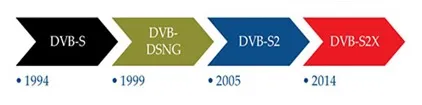
DVB-S Evolution Timeline
DVB-S2 Key Features
DVB-S2 includes the following new features, which help it to replace DVB-S and DVB-DSNG technologies:
- Powerful FEC (Forward Error Correction) based on LDPC codes
- Support for a wide range of coding rates, from 1/4 up to 9/10
- New modulation schemes offering 2-5 bits/second/Hz spectrum efficiency
- Support for three spectrum shapes using different roll-off factors: 0.2, 0.25, 0.35
- Support for flexible stream adaptation, suitable for operating with single and multiple TS (Transport Stream) on the same carrier with different modulation/FEC.
- VCM (Variable Coding & Modulation) / ACM (Adaptive Coding & Modulation) allows optimization of coding/modulation on a frame-by-frame basis.
Common applications of DVB-S2 include broadcasting services (TV, HDTV, FSS, BSS), digital TV contribution & satellite news gathering, VSATs, interactive data services including internet access, and data content distribution/trunking.
Advantages of DVB-S2
The following are the benefits of DVB-S2:
- It offers better forward error correction (FEC) performance, about 2-2.5 dB higher than DVB-S, making it more robust.
- It offers higher spectral efficiency, approximately 30% better than DVB-S, using less satellite capacity and consequently saving money.
- It provides increased data throughput in a given bandwidth (e.g., 36 MHz) compared to DVB-S.
- It supports an increased number of channels.
- It supports an increased coverage area.
- It allows the use of smaller dish antennas.
- The use of ACM in DVB-S2 offers rain fade counter measures on the forward link and allows optimum matching of the transmitter waveform to the channel conditions.
- The extension of DVB-S2, called DVB-S2X, offers very low C/N and many new features.
Disadvantages of DVB-S2
The following are the drawbacks of DVB-S2:
- The implementation complexity is very high compared to DVB-S.
- DVB-S2 is still evolving with constantly changing technologies.
- Millions of DVB-S devices have been deployed worldwide, making it challenging to upgrade all of these devices with DVB-S2.
- The upgrade process from DVB-S to DVB-S2 requires replacing set-top boxes and TVs with integrated DVB-S2 tuners.
Summary
DVB-S2 enhances satellite communication through advanced modulation and coding. Advantages include increased bandwidth efficiency, while disadvantages include hardware complexity and migration costs.
Continue Learning DVB (Digital Video Broadcasting)
Explore the global standards for transmitting digital television over satellite, cable and terrestrial networks.
- DVB-T vs DVB-S vs DVB-C vs DVB-H: Understanding the Differences
- DAB vs DVB vs DMB (Digital Multimedia Broadcasting)