
What is the difference between UART and USART
Advertisement
UART and USART are widely used serial communication interfaces in microcontrollers and embedded systems. The main difference between UART and USART is that UART supports only asynchronous communication, while USART supports both synchronous and asynchronous modes. UART stands for Universal Asynchronous Receiver/Transmitter where as USART stands for Universal Synchronous/Asynchronous Receiver/Transmitter.Understanding UART vs USART helps engineers choose the right communication protocol based on speed, clock synchronization and application requirements.
UART (Universal Asynchronous Receiver/Transmitter)
-
Full Name: Universal Asynchronous Receiver/Transmitter.
-
Data Rate: Generally supports lower data rates compared to USART.
-
Baud Rate Requirement: The receiver must know the transmitter’s baud rate before communication can begin. This means you need to agree on the speed beforehand.
-
Protocol Simplicity: UART is a relatively simple protocol. It relies on:
- A start bit (typically a low logic level) before the data word.
- One or two stop bits (typically a high logic level) after the data word.
- An optional parity bit (even or odd) for basic error detection.
The following image shows the structure:
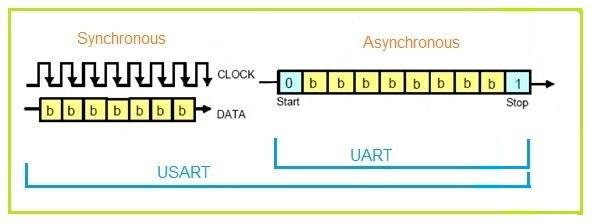
- UART Packet Structure: 1 start bit (low), 8 data bits (including parity), 1 or 2 stop bits (high).
- Transmission Style: Data is transmitted byte by byte.
- Clocking: UART generates its own internal clock and synchronizes it with the incoming data stream based on the transition of the start bit.
- RS232 Connection: UART is often referred to as RS232, a common serial communication standard.
- Voltage Levels: For longer distances, the standard 5V UART signal is often converted to higher voltages, such as +12V for logic 0 and -12V for logic 1 to improve signal integrity.
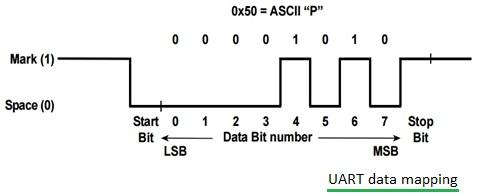
The following image shows the data mapping.
USART (Universal Synchronous/Asynchronous Receiver/Transmitter)
-
Full Name: Universal Synchronous/Asynchronous Receiver/Transmitter.
-
Data Rate: Supports higher data rates because it can generate a clock signal along with the data (synchronous mode).
-
Baud Rate Requirement: In synchronous mode, the receiver does not need to know the transmitter’s baud rate beforehand. This information is derived from the clock signal accompanying the data.
-
Transmission Style: Synchronous data is generally transmitted in blocks.
-
UART Compatibility: USART can be configured to operate like a UART, making it a more versatile option. However, a standard UART cannot emulate a USART’s synchronous capabilities.
-
Protocol Complexity: USART is more complex and can support various protocols for data transmission, including LIN, SPI, I2C, Modbus, and IrDA.
-
Clocked Data: The USART utilizes a clock signal to reliably detect and decode the data, typically sampling in the middle of each bit period.
Summary
UART operates exclusively in asynchronous mode and does not require a shared clock signal between communicating devices. In contrast, USART supports both asynchronous and synchronous communication, enabling higher data transfer efficiency when clock synchronization is available. While UART is simpler and widely used for basic serial communication, USART offers greater flexibility and performance for applications requiring faster and more reliable data exchange.
Advertisement


