
What is Serial Interface: Advantages and Disadvantages
Advertisement
A serial interface is a communication method that transfers data sequentially one bit at a time between electronic devices over a single communication channel. Its advantages include simple wiring, long distance communication, and reduced hardware complexity, whereas its disadvantages include lower throughput than some parallel interfaces and protocol specific limitations.
Serial Communication Interface
In serial communication, data bits are transmitted one after the other in a sequential manner using a single communication channel. An example of a serial interface is RS-232, which is a point to point and asynchronous interface. It’s commonly used for communication between devices, such as Data Terminal Equipment (DTE) and Data Communication Equipment (DCE). The protocol uses a start bit and stop bit for data communication.
Serial interfaces can have multiple lines, but only one line is typically used for data communication.
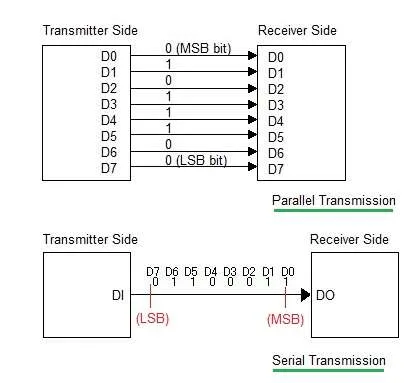
There are two primary methods in serial communication: synchronous and asynchronous.
- Synchronous Communication: Blocks of data (or characters) are transferred at a time.
- Asynchronous Communication: Single bytes (or bits) are transferred at a time.
Special Integrated Circuits (ICs) like UART (Universal Asynchronous Receiver/Transmitter) and USART (Universal Synchronous/Asynchronous Receiver/Transmitter) are used for this type of communication. Many microcontrollers, like the 8051, have built-in UART chips. PISO (Parallel-In Serial-Out) and SIPO (Serial-In Parallel-Out) shift registers are used to convert serial data into parallel data and vice versa.
Benefits or Advantages of Serial Interface
- Reduced Cost: It requires fewer conducting wires, which lowers the overall cost of the interface.
- Long Distance Communication: Supports data communication over longer distances.
- Simple Interface: Uses fewer wires, often just one, resulting in a simpler interface between transmitting and receiving devices or ICs. This also makes it easier to implement.
Drawbacks or Disadvantages of Serial Interface
- Slower Transmission Speed: Uses fewer lines for transmission between devices, resulting in slower transmission speeds.
- Overhead: Introduces an overhead of about 20% beyond the useful information. This leads to a waste of bandwidth meant for data transmission due to the additional, non-essential data.
Summary
Serial interfaces remain fundamental to embedded systems, industrial automation, computers, and communication equipment because they provide reliable and efficient device connectivity. Their practical advantages include simplified cabling and dependable long distance transmission, although performance depends on the selected serial communication standard and application requirements.