
What is Parallel Interface: Advantages and Disadvantages
Advertisement
A parallel interface is a communication method that transfers multiple bits of data simultaneously through several data lines. It enables high speed short distance communication between electronic devices but becomes less efficient over longer distances due to timing and signal synchronization challenges.
Parallel Interface : Comparison & Applications
A Parallel Interface is used for transmitting multiple data signals simultaneously over several parallel channels. In essence, multiple bits (typically 8) are transmitted at the same time on different channels within the same cable.
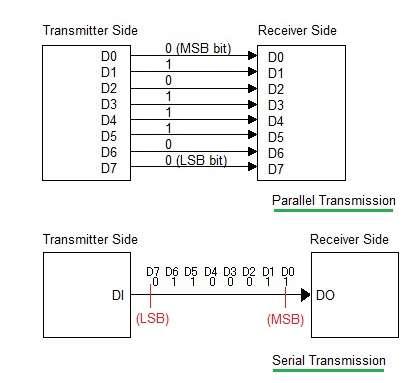 Image Alt: Parallel Interface
Parallel interfaces find applications within computers, especially along computer buses and between drive controllers and hard disk drives. Examples of parallel interfaces include ISA, ATA, PCI, SCSI, and IEEE-488. They are also commonly used within ICs, peripheral buses, and memory devices like RAM.
Benefits or Advantages of Parallel Interface
- It offers faster data communication between devices compared to serial interfaces.
Drawbacks or Disadvantages of Parallel Interface
-
It supports short-distance communication between devices. This limitation arises from crosstalk between the parallel lines.
-
It uses more wires compared to a serial interface, making it more costly and somewhat more complex to implement.
Summary
A parallel interface transfers multiple bits of data simultaneously using separate data lines, enabling high-speed communication over short distances. It is commonly used in computer hardware and embedded systems.
Advertisement


