
What is 2B1Q Line Coding : 5 Advantages and Disadvantages
Advertisement
2B1Q (2 Binary 1 Quaternary) is a digital line coding technique that maps two binary bits into one quaternary symbol, reducing bandwidth requirements. Advantages include improved spectral efficiency and reduced transmission rates, while disadvantages include increased complexity and noise sensitivity.
2B1Q is a bandwidth efficient technique which reduces the required baud rate by half compared to binary schemes, making it ideal for high speed digital communication over copper lines, such as in ISDN and DSL technologies.
2B1Q line coding procedure
2B1Q is a multilevel data encoding scheme used to encode patterns of ‘m’ data elements into patterns of ‘n’ signal elements. It is classified into different types as “mBnL,” where:
- m = length of binary pattern
- B = binary data
- n = length of signal pattern
- L = number of levels
Here, the first two letters indicate the data pattern, while the second two letters indicate the signal pattern. L=2 means Binary, L=3 means ternary, L=4 means Quaternary, etc.
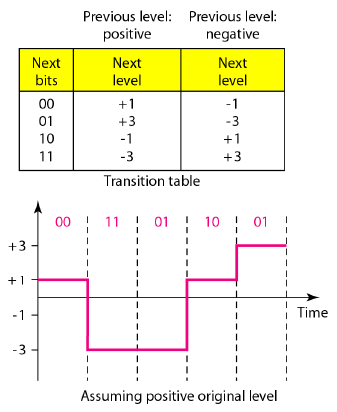
2B1Q refers to “two binary, one quaternary.” This line coding technique uses data patterns of size 2. It encodes 2-bit patterns as one of the signal elements belonging to a four-level signal.
Other multilevel encoding schemes include 8B6T and 4D-PAM5.
Advantages of 2B1Q Line Coding
Following are some of the benefits of 2B1Q line coding.
- Increased bits per baud: It helps increase the number of bits per baud, which is desirable in data communication.
- Bandwidth Savings: It can send more than one data bit with a single signal, saving bandwidth. The required average bandwidth equals N/4.
- No Redundant Signals: There are no redundant signal patterns in this technique, making efficient use of signal space.
- DSL Application: It is used in Digital Subscriber Line (DSL) to provide high-speed internet access.
- Voltage Balance: Typical codes balance voltage, leading to less baseline wandering.
Disadvantages of 2B1Q Line Coding
Following are some of the drawbacks of 2B1Q line encoding.
- Complexity: It is complex because the receiver has to distinguish between four different thresholds, as 2B1Q uses four different signal levels. This increases the complexity of the receiver design.
- Lack of Self-Synchronization: It lacks self-synchronization for long patterns of similar double bits, potentially leading to timing drift.
- DC Output Problems: Long sequences of zeros or “01” will have a constant DC output. Hence, the spectrum creates very low frequencies, which present problems in certain systems due to DC bias.
Summary
2B1Q line coding converts two bits into one quaternary symbol for efficient data transmission. Advantages include bandwidth savings, while disadvantages include higher implementation complexity and noise susceptibility.
Advertisement


