
What are Temperature Sensors : Thermocouple, RTD, Thermistor, IC Pros and Cons
Advertisement
Temperature sensors are electronic devices that measure heat or temperature using technologies such as thermocouples, RTDs, thermistors, and integrated circuit (IC) sensors. Their advantages include accurate temperature monitoring, real-time measurement, and wide industrial use, while their disadvantages vary depending on sensor type, operating range, response time, and calibration requirements.
This page explores the pros and cons of various types of temperature sensors, including thermocouples, Resistance Temperature Detectors (RTDs), thermistors, and IC sensors.
Definition: A temperature sensor is a device that detects changes in temperature. These sensors come in different forms, each with its own characteristics and applications, such as thermocouples, RTDs, thermistors, and integrated circuit (IC) based sensors.
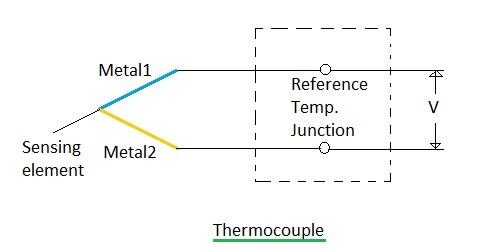
Figure 1: Temperature sensor of thermocouple type.
As shown in Figure 1, a thermocouple consists of two dissimilar metal wires joined at one end, with the other end open. The temperature difference between the junction and the open end creates a voltage. The voltage produced is dependent on the materials used for the wires and the temperature difference. Different thermocouple types exist, each using different metal combinations, resulting in varying sensitivities and measurable temperature ranges.
The advantages and disadvantages of a temperature sensor depend on the underlying sensing mechanism (RTD, thermistor, thermocouple, or ultrasonic transducer).
Advantages of Temperature Sensors (Thermocouple, RTD, Thermistor, IC Sensor)
- Temperature Range:
- Thermocouples: -200 °C to +2500 °C
- RTDs: -200 °C to +850 °C
- Thermistors: -100 °C to +260 °C
- IC Sensors: -45 °C to 150 °C
-
Thermocouple Advantages: No external power required, simple and robust construction, relatively inexpensive, wide temperature range.
-
RTD Advantages: More stable, higher accuracy, and more linear compared to thermocouples.
-
Thermistor Advantages: Higher output signal and faster response time.
-
IC Sensor Advantages: Highest output signal, lower cost, and more linear than other types.
Disadvantages of Temperature Sensors (Thermocouple, RTD, Thermistor, IC Sensor)
-
Thermocouple Disadvantages: Non-linearity, lower stability, low voltage output, requires a reference junction, and lower sensitivity.
-
RTD Disadvantages: Lower absolute resistance, more expensive, requires a current source, and less rugged compared to thermocouples.
-
Thermistor Disadvantages: Non-linearity, limited temperature range, requires a current source, fragile, and prone to self-heating.
-
IC Sensor Disadvantages: Requires a power supply, slower response time, self-heating, limited configurations, and a maximum temperature limit of around 150 °C.
Summary
Temperature sensors are essential in industrial automation, healthcare, consumer electronics, automotive systems, and scientific instrumentation for reliable thermal monitoring and control. Each sensor technology offers distinct performance advantages based on accuracy, sensitivity, operating environment, and cost, although selection should carefully consider measurement range, stability, response speed, and long-term reliability.
Advertisement


