
What is Seebeck Effect and Seebeck Coefficient
Advertisement
The Seebeck coefficient is a thermoelectric parameter that measures the voltage generated across a material when exposed to a temperature difference. It is a key characteristic of thermoelectric materials and is widely used in temperature sensing, energy harvesting, power generation and thermal management applications. Let us explore formula to calculate Seebeck Coefficient and understand actual values for common materials such as silicon and carbon.
Seebeck Effect
As we know, a thermocouple is made of two different types of wires composed of different materials. The conversion of heat energy into electrical energy at the junction of these dissimilar wires is known as the Seebeck Effect.
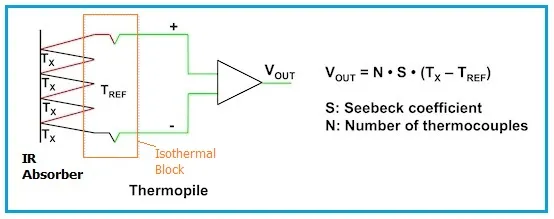
Seebeck Coefficient
The voltage output of a thermopile in response to a temperature difference across the material is known as the thermoelectric coefficient, or Seebeck Coefficient. It is measured in volts per kelvin (V/K) or mV/K.
Seebeck Coefficient Formula
The Seebeck coefficient can be calculated using the following formula:
Where:
- is the output voltage
- is the number of thermocouples used in the thermopile
- is the Seebeck coefficient
- is the temperature at the measurement junction
- is the temperature at the reference junction
The table below shows the Seebeck coefficient in µV/K relative to platinum for various materials.
| Material Type | Seebeck Coefficient (µV/K) |
|---|---|
| Silicon | 440 |
| Germanium | 330 |
| Copper, Silver, Gold | 6.5 |
| Cadmium, Tungsten | 7.5 |
| Lead | 4.0 |
| Aluminium | 3.5 |
| Carbon | 3.0 |
| Mercury | 0.6 |
Continue Learning Thermistors & Temperature Resistors
- Thermistor Basics: NTC vs PTC
- NTC vs PTC Thermistors: Understanding the Differences
- Barrettor vs Thermistor: Key Differences