
NTC vs. PTC Thermistors: Key Differences Explained
By RF Wireless Expert Team
Advertisement
This page clarifies the difference between NTC and PTC thermistors.
Introduction to Thermistors
- A thermistor is a semiconductor device whose resistance changes with temperature.
- It’s also known as a thermal resistor.
- Thermistors come in various shapes and sizes, like rods, discs, and beads.
NTC Thermistor
- NTC stands for Negative Temperature Coefficient.
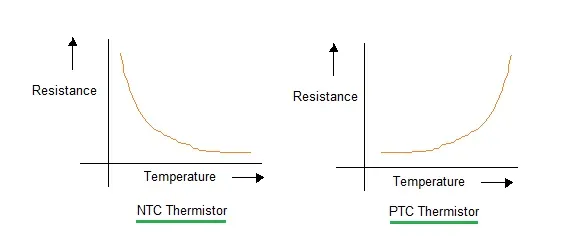
- In an NTC thermistor, resistance decreases as temperature increases, as illustrated below.
- NTC thermistors are made from oxides of nickel, cobalt, copper, manganese, and other materials.
- They’re commonly used for temperature control and measurement.
- NTC thermistors are typically used in the temperature range of -55°C to 200°C.
- Example: SMD KT series NTC thermistor chips manufactured by ATC Semitec Limited.
PTC Thermistor
- PTC stands for Positive Temperature Coefficient.
- In a PTC thermistor, resistance increases as temperature increases, as illustrated below.
- PTC thermistors are made using barium titanate.
- They are often used to protect electronic circuits from overheating.
- PTC thermistors are generally used in the temperature range of 0°C to 200°C.
- Example: SMD PTC thermistors (TPM series) manufactured by ATC Semitec Limited, which are used as thermal switches.