
What is NVMe SSD : Advantages and Disadvantages
Advertisement
An NVMe SSD (Non Volatile Memory Express Solid State Drive) is a high performance storage device that uses the PCIe interface to deliver significantly faster data transfer speeds than SATA based SSDs. NVMe drives improve application responsiveness and system performance. Their drawbacks include higher cost, increased thermal output, and compatibility considerations.
Introduction: NVMe stands for Non-Volatile Memory Express. It’s a protocol that enables data to be read from and written to storage devices through PCI-e. Essentially, it’s a host controller interface specifically designed to meet the demands of systems that utilize PCI express-based solid-state storage.
Key features of NVMe SSD
The NVMe version 1.0 specification was originally developed in 2011 by a consortium of member companies. Since then, several updated versions have been released. NVMe was created for NVM (Non-Volatile Memory) technologies, aiming to provide efficient access to storage devices built using NAND flash technology, as well as future high-performance persistent memory technologies.
NVMe employs a new architecture for storage, spanning from the software stack to hardware devices and systems. This design eliminates the hard drive legacy adopted by older interfaces like SATA and SAS.
Here are some key features of the NVMe interface protocol:
- Designed specifically for SSDs with Flash technology.
- Supports 64K command queues.
- Capable of sending 64K commands per queue, minimizing CPU cycles.
- Offers a low latency of approximately 2.8 microseconds.
- Communicates directly with the system CPU.
- Achieves Input/Output Operations per Second (IOPs) exceeding 1 million.
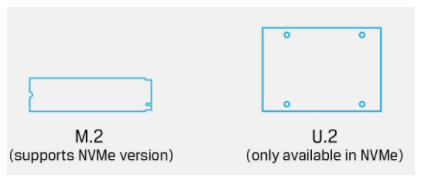
NVMe SSD Form Factors
NVMe utilizes various form factors, including the M.2 form factor, the U.2 2.5-inch drive form factor, and the AIC (Add-in PCIe card), each defining the size and shape of the SSD.
NVMe-based SSDs address critical performance aspects such as bandwidth, latency, and IOPs.
The NVMe protocol supports PCI express and fabrics like RDMA and fiber channel, and is compatible with a wide range of operating systems, including Linux, Windows, Chrome OS, UEFI, UNIX, and VMWare.
For a broader look, refer to the advantages and disadvantages of SSD in general.
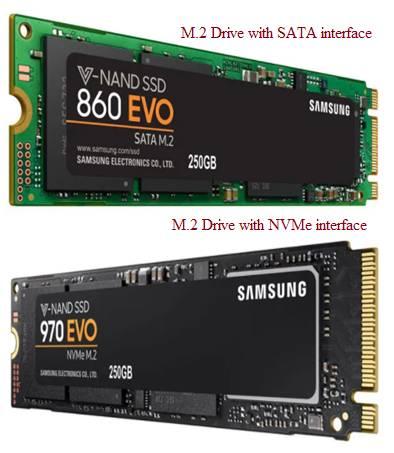
M-2 Drive for SATA and NVMe SSDs
Benefits or Advantages of NVMe SSD
- Superior Storage: PCIe sockets offer approximately 25 times more data transfer capacity compared to their SATA counterparts, leading to faster storage performance.
- Superior Speed: NVMe sends commands more than 2 times faster than AHCI (Advanced Host Controller Interface) SATA drives. IOPS can exceed 1 million, up to 900% faster than AHCI.
- Superior Compatibility: NVMe communicates directly with the system CPU, improving efficiency.
- Broad OS Support: NVMe-based SSDs work with all major Operating Systems, irrespective of the form factor.
- Low Latency: NVMe offers an end-to-end latency of under 10 microseconds, including the software stack.
- Data Privacy: NVMe supports tunneling protocols, addressing data privacy concerns.
- High Bandwidth: NVM express supports much higher bandwidth than SATA or SAS.
Drawbacks or Disadvantages of NVMe SSD
- Higher Cost: NVMe-based SSD devices generally cost more than standard 2.5” SSD devices.
- Limited Drive Selection in M.2 Format: Client PCs often use NVMe in the M.2 format, which can limit the selection of drives compared to other available solutions.
- Legacy System Incompatibility: Older systems may not support legacy NVMe, making it difficult to upgrade the storage system.
- Cost-Ineffective for Large Data Volumes: NVMe-based SSDs are not as cost-effective when it comes to storing large volumes of data.
Summary
NVMe SSDs provide ultra-fast storage performance for gaming, professional computing, data centers, and enterprise applications. Learn the advantages and disadvantages of NVMe SSDs, including high speed, low latency, improved productivity, thermal management requirements, and pricing factors.
Advertisement


