
What is Delta Sigma ADC : Key Advantages and disadvantages
Advertisement
A Delta Sigma ADC (Analog to Digital Converter) uses oversampling and noise shaping techniques to achieve high resolution signal conversion. It is widely used in precision measurement, audio systems, and instrumentation. Advantages include excellent accuracy and noise performance, while disadvantages include slower conversion speeds and increased processing complexity.
Delta Sigma ADC Block Diagram
Introduction : A Delta Sigma ADC converts analog signals into high resolution digital output by oversampling and noise shaping. It uses a modulator to produce a high frequency bitstream, which is then filtered and decimated to produce the final digital word. These ADCs excel in audio and precision measurement systems.
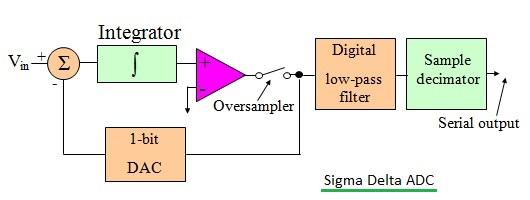
Figure : Delta sigma ADC
Figure shows the block diagram of a Sigma Delta ADC. The Serial Output is proportional to the analog input voltage.
Advantages of Delta Sigma ADC
Following are some of the benefits of Delta Sigma ADC.
- It supports highest resolution available.
- It offers excellent linearity.
- It supports inherent anti-aliasing (in CT implementations).
- It is robust to component mismatches.
- It offers good power efficiency at low speeds.
Disadvantages of Delta Sigma ADC
Following are some of the drawbacks of Delta Sigma ADC.
- It supports limited bandwidth.
- It offers high latency due to digital filtering.
- It uses complex digital signal processing (DSP) in its design.
- It has stability concerns in high order based loop designs.
Summary
Delta Sigma ADCs provide highly accurate analog to digital conversion for precision applications. Advantages include high resolution and noise immunity, while disadvantages include latency and speed limitations.
Advertisement


