
What is a Channel Identifier (CID) in BLE? | CID Values Table
Advertisement
In the Bluetooth architecture, the Channel Identifier (CID) is the local name representing a logical channel endpoint on a device. Because the L2CAP (Logical Link Control and Adaptation Protocol) layer acts as a multiplexer allowing multiple upper layer applications and protocols to share a single physical Bluetooth link; it needs a way to separate and route that traffic. It does this by assigning a unique CID to each data flow.
Key characteristics of CIDs
- Endpoint Identification: The logical connection between two endpoints in peer devices is characterized by their CIDs.
- Routing: When an L2CAP packet (PDU) is received, the Basic L2CAP header contains a 2-octet CID field. L2CAP uses this CID to route the “Information Payload” to the correct upper layer protocol (like ATT for GATT, or SMP for Security).
- Scope: CIDs are relative to a particular logical link. Two simultaneously active L2CAP channels on the exact same logical link cannot share the same CID. However, different logical links (e.g. BR/EDR vs. LE) have their own distinct CID name spaces.
- Fixed vs. Dynamic:
- Fixed Channels (0x0001 to 0x003F): Reserved for specific core Bluetooth functions. On BLE links, these fixed channels are available immediately once the logical link is established.
- Dynamically Allocated CIDs: Used for custom application data streams, established using connection mechanisms (like LE Credit Based Flow Control).
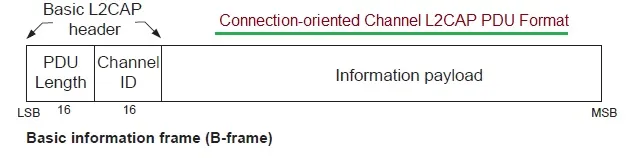
The figure-1 depicts L2CAP PDU format consists of PDU length, Channel ID and Information Payload.
BLE Channel Identifiers (CID) Table
| CID Value | Description | Channel Characteristics |
|---|---|---|
| 0x0000 | Null identifier | Not Allowed (Cannot be used as a destination endpoint) |
| 0x0004 | Attribute Protocol (ATT) | Used for discovering, reading, and writing attributes (underpins GATT). |
| 0x0005 | L2CAP LE Signaling channel | Used to establish L2CAP channels and negotiate parameters between devices. |
| 0x0006 | Security Manager protocol (SMP) | Used for pairing, bonding, and key distribution over LE. |
| 0x0020 to 0x003E | Assigned Numbers | Standardized numbers assigned by the Bluetooth SIG. |
| 0x0040 to 0x007F | Dynamically allocated | Communicated using the L2CAP LE credit based create connection mechanism. |
| All other values | Reserved for future use | Not applicable |
Note: For Classic Bluetooth / BR/EDR, the dynamic allocation range is much larger [0x0040 to 0xFFFF], but for BLE [LE-U], the dynamic range is restricted to 0x0040 to 0x007F as per the specification.
Most important fixed CIDs in BLE
-
CID = 0x0004 — ATT
- 0x0004 is the fixed channel for the Attribute Protocol. ATT messages are carried over an ATT bearer, and in LE the normal ATT bearer uses this fixed L2CAP channel. The specification states that the LE ATT bearer is available as soon as the ACL connection is established. Additional ATT bearers can also be established using L2CAP.
-
CID = 0x0005 — L2CAP LE
- 0x0005 is the L2CAP LE Signaling channel. It is used for L2CAP signaling rather than application data. The specification states that this channel becomes available when the LE-U logical link is established. It is involved in procedures such as establishing and controlling L2CAP connection-oriented channels.
-
CID = 0x0006 — SMP
- 0x0006 is the fixed channel for the Security Manager Protocol. It carries SMP traffic used for BLE security procedures. The Core Specification identifies it as Security Manager protocol, referring to the Security Manager specification.
References & Further Reading
- Bluetooth SIG : Bluetooth Core Specification Version 6.3, May 5, 2026.
- Bluetooth SIG : Bluetooth Technology Overview
Continue Learning Bluetooth Basic Concepts
- What are new features in Bluetooth 6.3 Version
- Bluetooth GATT Vs. ATT Vs. GAP : Key Comparison
- Bluetooth Service Vs. Characteristic Vs. Descriptor
- Bluetooth Central Vs. Peripheral : Key Differences
- Bluetooth Notifications Vs. Indications
- Bluetooth Channel Sounding Vs. RSSI
- Bluetooth Direction Finding Methods : AoA Vs. AoD
- Bluetooth Error Codes Guide : Meanings, Causes & Fixes
- Bluetooth L2CAP and HCI : Key Differences
Continue Learning Bluetooth Technology
- Bluetooth Basics Tutorial
- Bluetooth Low Energy (BLE) Basics Tutorial
- Bluetooth Protocol Stack & Device State Diagram
- Bluetooth Physical Layer Modules
- Bluetooth MAC Layer Overview
- Bluetooth Channel Frequency List
- Bluetooth Network Security
- Bluetooth Low Energy (BLE) Connection Establishment Procedure
- Bluetooth Profiles: HFP, HSP, A2DP, AVRCP, PBAP & MAP
- Bluetooth Mesh Node Types & Protocol Stack Layer Functions