
What is Barkhausen Criteria: Loop Gain & Phase Shift
Advertisement
The Barkhausen Criteria define the conditions required for sustained oscillations in an electronic oscillator circuit. According to the criteria, the loop gain must be equal to one and the total phase shift around the feedback loop must be zero or an integer multiple of 360 degrees. Let us understand concept and explore difference between the first and second Barkhausen criteria.
If a negative feedback circuit satisfies the following two conditions, the circuit may oscillate at a specific frequency, denoted as W0.
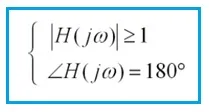
Barkhausen Criteria
Based on the principles illustrated above, we can define the Barkhausen criteria as follows:
- Loop Gain: A * Β >= 1
- Phase Shift: The phase shift around the entire circuit loop must be 2π (360 degrees) or a multiple of 2π.
First Barkhausen Criterion
The first Barkhausen criterion focuses on ensuring reliable oscillation. In practice, we typically design the loop gain (A*B) to be at least two or three times greater than the minimum required value (1). This safety margin compensates for variations in temperature, component tolerances, and other process-related fluctuations that could otherwise prevent sustained oscillations.
Second Barkhausen Criterion
The second Barkhausen criterion addresses the phase shift requirement for oscillation. This criterion can be stated as follows:
- A 180-degree phase shift criterion is equivalent to a complete 360-degree loop phase shift.
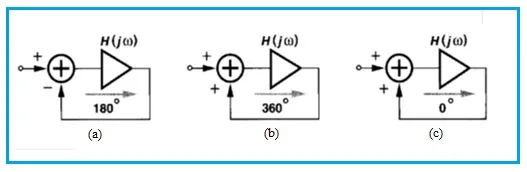
Second Barkhausen Criterion
- Figure-2a illustrates a scenario where a 180-degree phase shift is introduced by the negative feedback network, while the amplifier contributes the remaining 180 degrees.
- Figure-2b depicts a situation where the amplifier alone provides the entire 360-degree phase shift.
- Figure-2c shows that a phase shift of 2nπ (where ‘n’ is an integer) functions identically to the scenario in Figure-2b, as it represents a complete rotation around the phase circle.
Continue Learning Oscillator Fundamentals & Types
- Oscillator Types
- Voltage Controlled Oscillators (VCOs)
- NE 566 VCO and its application in PLL Design
- Numerically Controlled Oscillator (NCO) and its use in DDS Design
- Understanding YIG Oscillators
- Backward Wave Oscillators (BWO): Advantages & Disadvantages
- OCXO SC Cut Crystal Oscillator: Advantages & Disadvantages
- Understanding Oven-Controlled Crystal Oscillators (OCXO)