
What is a Balun : Advantages and Disadvantages
Advertisement
A balun (balanced to unbalanced transformer) is an RF component used to connect balanced transmission lines or antennas to unbalanced systems. It improves impedance matching, minimizes signal reflections, and enhances antenna performance. Advantages include reduced interference and better signal transfer, while disadvantages include insertion loss, bandwidth limitations, and additional system complexity.
What is a Balun? (Introduction)
- A balun is a device that connects a balanced transmission line to an unbalanced transmission line.
- The name “balun” is short for “balanced-unbalanced.” It essentially matches two different impedances.
- For instance, a balun transformer might connect a transmission feed line to an antenna.
- In this scenario, it might convert impedance from 300 ohms to 75 ohms, or vice versa. Here, 300 ohms represents free space impedance, and 75 ohms is the impedance of a coaxial line.
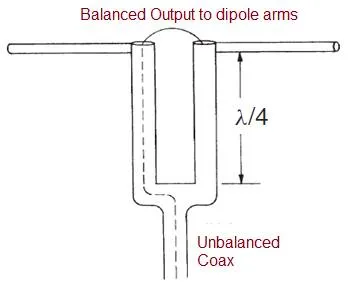
Figure 1 shows a folded balun. It enables a direct connection between a coax line and a dipole antenna.
There are many types of baluns including folded baluns, sleeve baluns, split coax baluns, half-wavelength baluns, candelabra baluns, ferrite core baluns, ferrite candelabra baluns, transformer baluns, split tapered coax baluns, and microstrip baluns.
As mentioned before, balun transformers primarily serve two functions:
- Impedance transformation
- Balanced-to-unbalanced transmission
Benefits (Advantages) of Baluns
The following are some of the benefits and advantages of using baluns in various applications:
- They facilitate interfacing between many types of antennas (dipoles, loops), which are balanced loads, and their feeders, which are unbalanced transmission lines (e.g., coax cable).
- They are used for proper connection of a parallel line to a transceiver with a 50-ohm unbalanced output.
- They prevent unwanted RF currents from flowing into the third conductor of a coaxial cable.
- Transformer type baluns have electrically separate windings for the input and output. This enables baluns to connect circuits that are electrically incompatible. Thus, these transformer baluns are also known as isolation transformers.
Drawbacks (Disadvantages) of Baluns
The following are some of the drawbacks and disadvantages of using baluns:
- Certain types of baluns can cause high attenuation of the signal.
- Their cost can be relatively high.
- Some balun types have complex geometries, making them difficult to manufacture.
- The advantages and disadvantages can vary significantly based on the specific balun type. Therefore, you should always refer to the specifics of a given balun type for a comprehensive understanding.
Summary
A balun is an RF device that converts balanced signals to unbalanced signals for efficient antenna and transmission line connections. Its advantages include improved impedance matching and reduced noise, while disadvantages include insertion loss and frequency limitations.