
What is ATDMA in DOCSIS : Advantages and Disadvantages
Advertisement
ATDMA (Advanced Time Division Multiple Access) is an upstream transmission technology used in DOCSIS cable networks to improve bandwidth efficiency and support higher data rates. Advantages include enhanced spectrum utilization and network capacity, while disadvantages include increased system complexity and dependence on network synchronization.
What are TDMA and FDMA?
TDMA (Time Division Multiple Access), FDMA (Frequency Division Multiple Access), and CDMA (Code Division Multiple Access) are all multiple access techniques. These techniques are crucial for resource allocation, allowing multiple subscribers or users to share access to a shared medium or channel.
-
FDMA: Divides the allocated frequency spectrum into distinct carrier frequencies, each referred to as a “channel.” These carrier frequencies are separated by a channel spacing to prevent interference. FDMA enables simultaneous operation by multiple subscribers, each using a unique frequency.
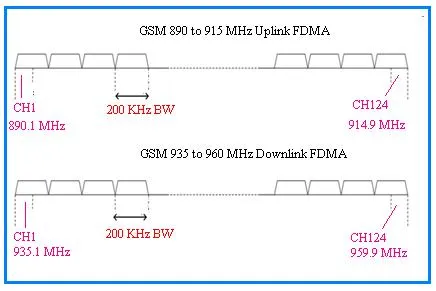 Figure-1: FDMA in GSM900
 -
TDMA: In the TDMA scheme, multiple subscriber devices (like cable modems) share the same RF channel but utilize different time slots.
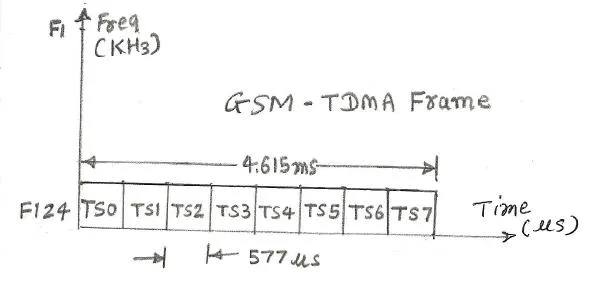 Figure-2: TDMA in GSM900
As the figure illustrates, GSM channels are assigned time slots; with each channel having multiple slots that are used by different subscribers. TDMA is also implemented in DOCSIS networks for communication between cable modems and CMTS (Cable Modem Termination System).
What is ATDMA?
DOCSIS 1.x employs TDMA multiplexing at the Physical layer. This allows cable modems to share the same RF carrier frequency (i.e., channel) during different time slots. In DOCSIS 2.0 and later standards, this TDMA scheme has been enhanced and is referred to as “ATDMA,” which stands for Advanced Time Division Multiple Access.
ATDMA is primarily used in the upstream direction with a bandwidth of up to 6.4 MHz at 5.12 Msym/sec. It supports modulation types like 8QAM, 32QAM, and 64QAM. The physical layer incorporates FEC (Forward Error Correction), burst interleaving, and a 24-tap equalizer.
Advantages of ATDMA
-
Improved Spectrum Efficiency: ATDMA allows multiple cable modems to access the cable network simultaneously at the same frequency but during different time slots. This increases the overall spectrum efficiency of the DOCSIS system.
-
Robust Physical Layer: ATDMA utilizes FEC (Forward Error Correction) and byte interleaving to mitigate impulse noise and burst noise, resulting in a more robust physical layer.
-
Higher Throughput: Compared to the TDMA used in DOCSIS 1.x, ATDMA supports wider bandwidths and higher-order modulation schemes (8QAM, 32QAM, and 64QAM). This allows ATDMA to support significantly higher throughput rates.
Disadvantages of ATDMA
-
Susceptibility to Impulse Noise: ATDMA performs less effectively than SCDMA (Synchronous Code Division Multiple Access) in environments with significant impulse noise.
-
No Load Balancing: ATDMA does not inherently support load balancing techniques.
Summary
ATDMA improves upstream performance in DOCSIS cable networks. Advantages include better bandwidth efficiency and capacity, while disadvantages include synchronization requirements and implementation complexity.
Continue Learning DOCSIS Architecture & Fundamentals
- DOCSIS Architecture Explained
- DOCSIS RF Frequency Range and Bandwidth
- DOCSIS 3.0 vs 3.1 vs 4.0: Understanding the Differences
- DOCSIS 3.1 vs DOCSIS 4.0: Advantages and Benefits