
What is Loop Antenna : Advantages and Disadvantages
Advertisement
A loop antenna consists of one or more turns of wire arranged in a circular, square, or rectangular shape to transmit or receive radio signals. It is commonly used in direction finding, RFID, and AM radio applications. Advantages include compact size and noise rejection, while disadvantages include limited bandwidth and lower efficiency.
Key features of Loop Antenna and its radiation pattern
Introduction: A loop antenna consists of one or more turns of wire, typically shaped in a circular or rectangular form, as illustrated in Figure 1.
The critical characteristic of a loop antenna is that its dimensions are significantly smaller than the wavelength of the signal it’s intended to receive or transmit. This ensures that the current flowing throughout the loop remains largely in phase.
The loop antenna generates a magnetic field (H) that surrounds it, oriented perpendicularly to the loop at every point.
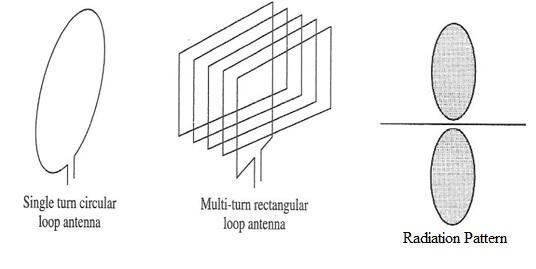
The radiation pattern of a loop antenna closely resembles that of an elementary doublet, as shown in Figure 2. This means that minimal radiation is received perpendicular to the plane of the loop. This characteristic makes it useful for direction-finding applications.
Benefits or Advantages of Loop Antennas
- Lightweight: They are relatively light in weight, making them easy to handle and mount.
- Simple and Compact: Loop antennas boast a simple and compact structure, contributing to their ease of use.
- Economical: They are generally inexpensive to manufacture and deploy.
- Portable Applications: Loop antennas are well-suited for portable applications, such as direction finding.
- Variety: They come in a variety of designs, including Adcock antennas, Alford loops, cloverleaf antennas, and Bellini-Tosi antennas.
Drawbacks or Disadvantages of Loop Antennas
- Poor Efficiency (Small Loops): Small loops exhibit poor efficiency, making them primarily suitable as receiving antennas at lower frequencies.
- Low Radiation Resistance (Small Loops): Small loop antennas have a very low radiation resistance. This leads to power loss in the form of heat due to the flow of current at high levels. For this reason, larger loop antennas are often preferred.
Summary
Loop antennas are compact antennas used for RF reception and direction finding. Advantages include good noise immunity and portability, while disadvantages include narrow bandwidth and reduced gain.
Advertisement


