
What is Log Periodic Antenna : Advantages and Disadvantages
Advertisement
A log periodic antenna is a broadband directional antenna designed to operate efficiently across a wide frequency range. It is commonly used in communication systems, EMC testing, broadcasting, and spectrum monitoring applications. Advantages include wide bandwidth and consistent performance, while disadvantages include larger physical size and moderate gain compared to specialized antennas.
Log Periodic Antenna Design Structure
The Log Periodic Antenna is composed of an array of dipoles, each with varying lengths and spacings.
The array is fed by a two wire line that is transposed between each dipole pair. Feeding occurs from the narrower end, resulting in maximum radiation, as illustrated in Figure 1.
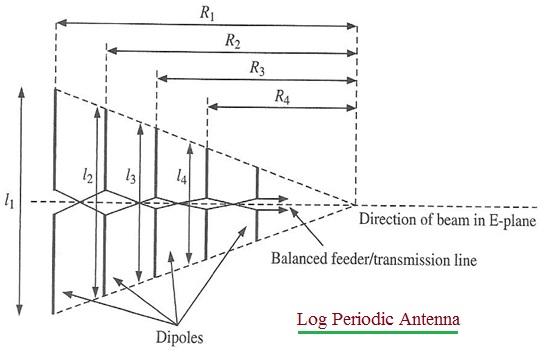
Log Periodic Antenna structure
The following mathematical equation is used in the design of a Log Periodic Antenna:
- R1/R2 = R2/R3 = R3/R4 = τ = l1/l2 = l2/l3 = l3/l4
Where:
- τ is the design ratio and is less than 1.
Two lines drawn connecting the opposite ends of the dipoles are straight and convergent, forming an angle α.
Typical values for τ and α are 0.7 and 30 degrees, respectively.
LPDA (Log Periodic Dipole Array) antennas come in two types:
- LPDA Straight type
- LPDA Vee type
Benefits or Advantages of Log Periodic Antennas
- The radiation resistance and pattern of the antenna do not depend on frequency.
- A 10:1 Bandwidth can be achieved with a simple design. This wide bandwidth is a significant advantage compared to YAGI and other antenna types.
- Low to moderate gains can be obtained.
- It offers unidirectional and bidirectional radiation patterns. It is a highly directional antenna.
- It can be used for HF/VHF/UHF communication as well as for TV reception.
- It is available in a wide variety of shapes.
- It is used for two-way communication requiring multiple frequencies.
Drawbacks or Disadvantages of Log Periodic Antennas
- Log Periodic antennas require a higher number of elements for lower frequencies in the HF/VHF bands.
- The antenna offers lower gain compared to YAGI antennas of the same size.
- They are not used for omnidirectional applications.
- They have a low polarization ratio.
Summary
Log periodic antennas provide broadband coverage for RF testing and communication applications. Advantages include wide frequency operation and versatility, while disadvantages include larger dimensions and lower gain than narrowband alternatives.
Advertisement


