
What are AM and FM modulations : Advantages and Disadvantages
Advertisement
AM (Amplitude Modulation) and FM (Frequency Modulation) are analog communication techniques used to transmit information through carrier waves. AM offers simple implementation and long range coverage, while FM provides better noise immunity and audio quality. Their advantages and disadvantages depend on bandwidth requirements, signal quality and communication applications.
What is AM Modulation?
AM stands for Amplitude Modulation AM is a modulation technique where the amplitude of the RF carrier signal is varied in accordance with the amplitude of the modulating input signal.
Advantages of AM (Amplitude Modulation)
- AM signals are reflected back to earth from the ionosphere layer. Due to this, AM signals can reach far places, thousands of miles from the source. Hence, AM radio has wider coverage compared to FM radio.
Disadvantages of AM
- The most natural as well as man-made radio noise is of the AM type. AM receivers do not have any means to reject this kind of noise.
- Weak AM signals have low magnitude compared to strong signals. This requires an AM receiver to have circuitry to compensate for the signal level difference.
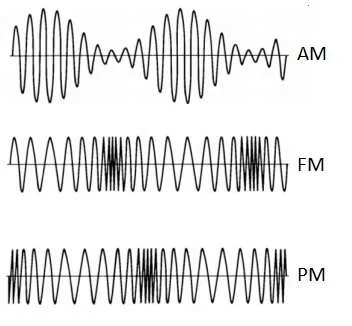 Figure-1 : AM vs FM vs PM
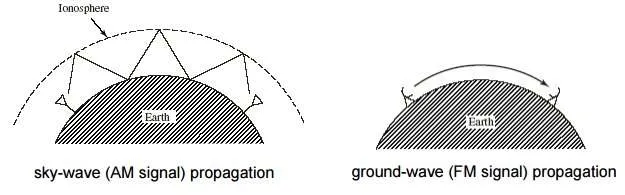 Figure-2 : AM & FM Propagation
Figure 2 depicts AM propagation. As shown, AM propagation happens due to reflection from the ionospheric layer.
What is FM Modulation?
FM stands for Frequency Modulation. FM is a modulation technique where the frequency of the RF carrier signal is varied in accordance with the frequency of the modulating input signal. Figure 2 depicts FM propagation. As shown, FM propagation relies on a Line of Sight communication path.
Advantages of FM (Frequency Modulation)
- In FM, the recovered voice depends on frequency and not amplitude. Hence, the effects of noise are minimized.
- FM bandwidth covers the entire frequency range humans can hear. Hence, FM radio has better sound quality compared to AM radio.
Disadvantages of FM
- At higher frequencies, FM modulated signals pass through the ionosphere and do not get reflected. Hence, FM has lesser coverage compared to AM signals.
Summary
AM and FM modulation techniques are widely used in radio communications. AM offers simplicity and coverage, while FM provides superior sound quality and noise resistance.
Continue Learning AM, FM, PM and More Modulation Types
- AM Vs. FM Vs. PM : Difference between Analog Modulation Techniques
- ASK Vs. FSK Vs. PSK : Difference between Digital Modulation Techniques
- PAM Vs. PWM Vs. PPM : Difference between Pulse Modulation Techniques
- BPSK Vs. QPSK : Key Differences
- 16-QAM Vs. 64-QAM Vs. 256-QAM : Key Differences
- 512-QAM Vs. 1024-QAM Vs. 2048-QAM Vs. 4096-QAM
- 4096QAM Modulation Used in Wi-Fi 7
- MSK Vs. GMSK : Modulation Technique used in GSM
- LORa Modulation Used in LoRaWAN
- 10% ASK & 100% ASK Modulation used in NFC
- OOK Vs. VPPM Vs. CSK : Visible Light Communication (VLC) Modulation Techniques
- QPSK Vs. OQPSK Vs. PI/4 QPSK
- PAM4 Modulation Used in Gigabit Ethernet
- CCK Vs. DSSS Vs. OFDM Used in WLAN (Wi-Fi) Standards