
VSWR Calculator & Formula using ZL, Z0 and S11
Advertisement
VSWR (Voltage Standing Wave Ratio) is a measure of impedance matching in RF systems. It quantifies how well the load impedance (ZL) matches the characteristic impedance (Z0) of a transmission line. A VSWR of 1:1 indicates perfect matching, while higher values indicate greater mismatch and potential signal reflections.
It is derived from the reflection coefficient (Γ), which is the ratio of the reflected wave amplitude to the incident wave amplitude. The VSWR can be calculated using either the load and characteristic impedances or the S11 parameter in dB. Understanding and calculating VSWR is crucial for designing efficient RF systems, minimizing signal loss and ensuring optimal performance of antennas and transmission lines.
VSWR using ZL, Z0 & S11
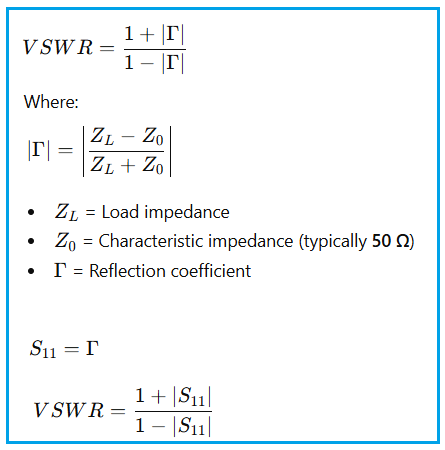
There are two common methods to calculate VSWR :
- Using Load Impedance (ZL) and Characteristic Impedance (Z0)
- Using S11 parameter in dB
The formula to measure VSWR as per above two cases are as follows.
VSWR Calculator using ZL, Z0 and S11
VSWR Calculation Example:
- Inputs : Z0 = 50 Ohms, ZL = 75 Ohms, S11 = -10 dB
- Outputs : VSWR based on Z0 and ZL = 1.499, VSWR based on S11 = 1.92
Conclusion
VSWR is a critical parameter in RF engineering that indicates the quality of impedance matching in a system. By calculating VSWR using either the load and characteristic impedances or the S11 parameter, engineers can assess the performance of RF components and optimize designs for maximum efficiency and minimal signal loss. A low VSWR indicates good matching and efficient power transfer, while a high VSWR suggests significant reflections and potential performance issues. Understanding and managing VSWR is essential for ensuring the reliability and effectiveness of RF systems.
Advertisement


