
Magic Tee (Hybrid Tee Junction) Formula and Calculator
Advertisement
Scenario: A microwave source delivers 20 mW of power to the H-plane arm (Port 3) of a Magic Tee. All other ports are terminated with matched loads. Calculate the power at Ports 1, 2 and 4.
EXAMPLE:
INPUTS:
- Input power to port-3 = 13 dBm (~ 20 mW)
OUTPUTS:
- Output power at port-1 = 9.989 dBm (~ 10 mW)
- Output power at port-2 =9.989 dBm (~10 mW)
- Output power at port-4 = 0 (Due to isolation between port 3 and port 4)
Magic Tee Formula
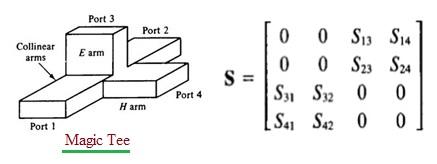
As mentioned in the following figure, properties of ideal and perfectly matched Magic Tee are defined by its 4 x 4 scattering matrix (S-matrix). The standard port are as follows.
- Ports 1 and 2 : Collinear arms (Side arms)
- Port 3 : H-Plane Arm (i.e. Sum Port)
- Port 4 : E-Plane Arm (i.e. Difference port)
Following equations are used in this magic tee calculator.
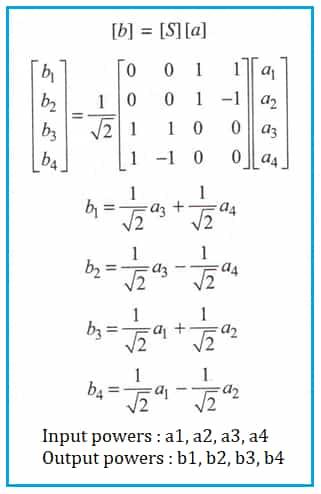
Key Properties:
- All ports are perfectly matched.
- Ports 1 and 2 are isolated and ports 3 and 4 are isolated.
- Signal entering port-3 divided equally and in-phase between ports 1 and 2
- Signal entering port-4 divides equally but 180 degree out-of-phase between ports 1 and 2.
Advantages of Magic Tee
- High isolation between ports
- Power combining/dividing capability
- Phase comparison capability
- Low insertion loss
Summary: The 20 mW input is split equally (10 mW each) between the collinear arms, with no power leaking into the E-plane arm.
References for further study
Text Books:
- Liao, Samuel Y., Microwave Devices and Circuits, 3rd Edition
- D. M. Pozar - Microwave Engineering, 4th Edition
- Concepts and Applications of Microwave Engineering by Sanjay Kumar and Saurabh Shukla
Academic / Standards References:
- IEEE Microwave Theory and Techniques Society (MTT-S) publications
- MIT Microwave Engineering Lecture Notes (Hybrid Junctions)
- NPTEL Microwave Engineering Course (IIT Kharagpur)
Advertisement


