
Power Density Calculator | EM & RF Power Tool
Advertisement
This tool is typically used in RF engineering to determine the power per unit area at a distance from a transmitting antenna. It is used to assess exposure levels to electromagnetic fields and ensure compliance with safety standards.
Why is Power Density Important?
Power density is crucial for evaluating the intensity of electromagnetic fields, particularly in RF applications. It helps in ensuring that exposure levels remain within safe limits, protecting both human health and sensitive electronic equipment from potential interference.
EXAMPLE: A 10 Watt transmitter connected to an antenna with a gain of 2 (3 dB) at a distance of 5 meters.
-
INPUTS:
- Power (P) = 10 W
- Gain (G) = 3 dB (which is 2 in linear scale)
- Distance (r) = 5 m
-
OUTPUT:
- Power Density (S) = 0.0635 W/m²
Power Density Formula
The following equation or formula is used for the Power Density calculator.
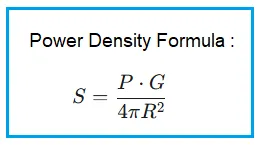
Where:
- S = Power Density (W/m²)
- P = Power (W)
- G = Gain (unitless)
- r = Distance from source (m)
- 4π = Constant (approximately 12.566)
Key benefits
- Safety Compliance: Helps ensure that RF exposure levels are within regulatory limits.
- Health Protection : Aids in minimizing health risks associated with electromagnetic field exposure.
- Versatile Applications: Useful for antenna design, RF system planning, and electromagnetic field assessments.
Applications of Antenna Power Density
- Wireless Coverage Planning : Power density helps engineers determine how strong the signal will be at various distances from a base station or access point (e.g., mobile towers, Wi-Fi routers).
- Benefit: Ensures reliable coverage and adequate signal strength for users.
- Antenna and System Design : Designers use power density to predict how radiation spreads in space and to optimize antenna parameters (gain, pattern) so that desired areas are adequately served.
- Benefit: Improves efficiency and performance of communications systems, reducing blind spots and wasted energy.
- Link Budget and Communication Performance : In radio communications (e.g., satellite links, cellular networks), power density at the receiver distance is a critical part of link-budget calculations (such as using the Friis transmission equation).
- Benefit: Helps determine whether the received signal level will be enough for data to be decoded accurately.
- Radar and Detection Systems : Radars depend on sufficient power density at various distances to detect objects reliably — the stronger the power arriving at a target and reflected back, the better the detection.
- Benefit: Enhances range, accuracy, and sensitivity of radar systems used in air traffic control, weather monitoring, military tracking, and marine navigation.
- Electromagnetic Safety & Regulatory Compliance : Regulatory limits often specify maximum allowable power density at given distances to protect people from harmful exposure to radiofrequency (RF) energy.
- Benefit: Ensures antennas comply with health and safety standards (e.g., limits for public and occupational exposure).
- Electromagnetic Interference (EMI) Assessment : Knowing power density allows engineers to estimate whether an antenna might interfere with nearby electronic systems or sensitive equipment.
- Benefit: Helps reduce interference in complex environments, improving reliability of all radio systems in the area.
- Satellite and Space Communications : In space communications, power density is used to make sure the signal from a satellite or ground station remains strong enough when it reaches distant receivers.
- Benefit: Critical for TV broadcasts, GPS, remote sensing, deep space links, and internet via satellite.
- RFID and IoT Systems : In radio-frequency identification (RFID) and Internet of Things (IoT) applications, power density levels determine how far tags or sensors can communicate with readers.
- Benefit: Ensures adequate reading range and reliable tag detection.
- Wireless Power Transfer (WPT) : For systems that transfer energy wirelessly (e.g., wireless charging), power density calculations help design safe and efficient energy transfer between transmitter and receiver.
- Benefit: Improves efficiency and safety in WPT applications.
Summary
Power density is a key parameter in RF and electromagnetic field analysis, providing insights into the intensity of radiation emanating from antennas and other sources. This calculator simplifies the process of determining power density, helping engineers and safety professionals ensure compliance with exposure guidelines.
References
- “Antenna Theory: Analysis and Design” by Constantine A. Balanis
- FCC Guidelines on RF Exposure
- IEEE Standard C95.1-2019 for Safety Levels with Respect to Human Exposure to
- Radio Frequency Electromagnetic Fields, 3 kHz to 300 GHz
- “Electromagnetic Fields and Waves” by Paul Lorrain and Dale Corson
- “RF Exposure and You” - National Institute of Environmental Health Sciences (NIEHS)
- World Health Organization (WHO) - Electromagnetic fields and public health