
What is RF Coupler: Advantages and Disadvantages
Advertisement
An RF coupler is a passive microwave component that samples, splits, or combines radio frequency power between transmission lines while maintaining controlled signal characteristics. Its advantages include accurate power monitoring and efficient signal distribution, while its disadvantages include insertion loss, limited bandwidth, and frequency dependent performance variations.
RF Coupler Selection Guide & features
An RF coupler is a passive device that couples a specific amount of input RF signal power and redirects it to another port, known as the coupled port. The remaining RF input signal power is directed to the output port after a certain amount of insertion loss. The coupler is directional in delivering outputs, hence the name “directional coupler.”
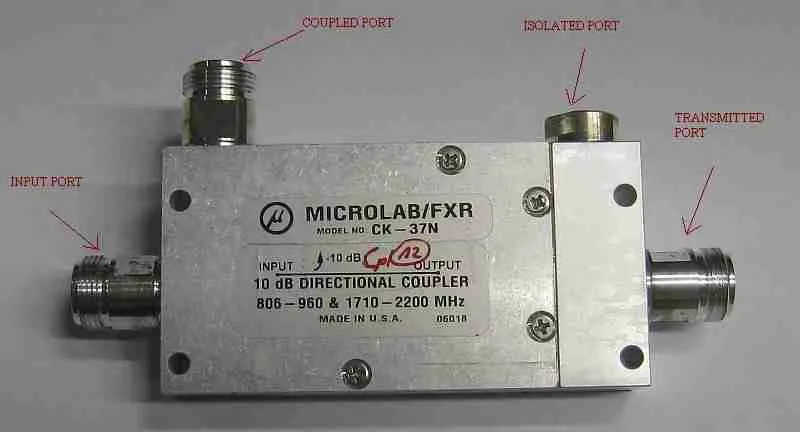
The figure below depicts a 10 dB directional coupler, with its ports marked as Input, Output, Isolated, and Coupled.
RF Coupler Specifications
The following specifications are important to consider when selecting an RF coupler:
- Operating frequency range
- VSWR (Voltage Standing Wave Ratio) or return loss
- Intermodulation point for 2 tones
- Power rating (Max.)
- Directivity
- Impedance
- Coupling value (6 dB, 10 dB, 15 dB, 20 dB, 30 dB)
- Frequency sensitivity
- Coupled loss
- Dissipative loss
- Connectors at its ports
- Other parameters: Weight, Size, Cost
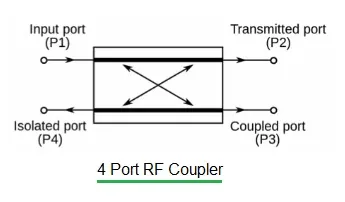
The figure above depicts a 4-port RF coupler schematic. It shows the input port (P1), transmitted port (P2), coupled port (P3), and isolated port (P4). In a 3-port coupler, the isolated port isn’t provided as an external connection.
The coupling factor can be expressed as follows:
C = 10 * log10 (P1/P3)
Where:
- P1 is the input power
- P3 is the power at the coupled port
Benefits or Advantages of RF Couplers
- Signal Monitoring: It’s used to monitor an RF signal by coupling without disrupting the main signal. This is valuable in test & measurement and troubleshooting scenarios.
- Signal Splitting: It’s used to split the signal into multiple outputs.
- Versatility: They are designed for a wide range of frequencies and power levels, making them useful for a wide array of applications.
- Ease of Use: They are very easy to install and use.
- Improved SNR: Low insertion loss RF couplers can help improve the Signal-to-Noise Ratio (SNR) of a signal, consequently improving system efficiency.
Drawbacks or Disadvantages of RF Couplers
- Insertion Loss: It introduces insertion loss to the RF signal. Hence, RF couplers are not suitable for applications where signal strength and quality are crucial parameters.
- Power Handling: RF couplers handle a specific amount of power. Always check the maximum power handled by the RF coupler before purchasing.
- Frequency Range and Isolation: RF couplers support a specific frequency range and offer different amounts of isolation between their input and output ports. Ensure you check the frequency range and isolation specifications according to your application or usage; otherwise, it will not deliver the desired performance.
Summary
RF couplers play a vital role in communication, radar, measurement, and RF testing applications by enabling controlled signal distribution and monitoring. Their advantages include reliable power sampling and system flexibility, while design complexity, bandwidth limitations, and unavoidable insertion losses influence their overall performance.
Explore RF Test & Measurements Resources
- RF Measurements Basic Tutorial
- OFDM Physical Layer & RF Measurements
- RF LNA Test Procedure & its Measurements
- RF Wafer Probe Testing and On-Wafer Measurement
Explore More RF Test Cases
- RF Receiver Sensitivity Measurement
- RF Receiver Overload Test Measurement
- RF Phase Noise Measurement
- ACPR Measurement
- RF Harmonic Distortion Measurement
- RF Intermodulation Distortion Measurement
- RF Gain Flatness Measurement
- RF Filter Measurements
- RF Antenna Measurements & Optimization
- RF Synthesizer Settling Time Measurement