
LiDAR Received Power Calculator | Link Budget Formula
Advertisement
This document explains how to calculate the received power (Pr) at a LiDAR sensor using the LiDAR link budget formula. It provides the relevant equation and a calculator for determining Pr based on transmitted power, receiver area, backscatter coefficient and range.
Example:
Input:
- Transmitted Power (Pt) in Watt: 1
- Receiver area (Ar) in m^2: 0.01
- Backscatter Coefficient (Beta) in m^-1 sr^-1: 1e-6
- Range in meters: 1000
Output:
- Received Power (Pr) in mW: 1e-11
LiDAR Received Power Formula
- Following the LiDAR equation, the received power (Pr) can be calculated as:
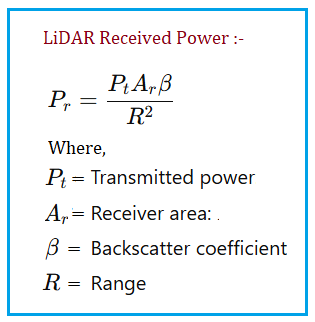
where:
- Pt = Transmitted Power (W)
- Ar = Receiver Aperture Area (m^2)
- Beta = Backscatter Coefficient (m^-1 sr^-1)
- R = Range to Target (m)
Applications/Benefits of LiDAR Received Power Calculation
- Sensor Design: Calculating received power helps engineers design LiDAR systems with sufficient sensitivity and range for applications like autonomous vehicles and remote sensing.
- Performance Analysis: Understanding received power allows for performance analysis of LiDAR systems under different environmental conditions, such as fog, rain or dust.
- Signal to Noise Ratio (SNR) Estimation: Received power calculations are essential for estimating the SNR of LiDAR returns, which impacts the accuracy and reliability of distance measurements.
- Range Estimation: By calculating received power, you can estimate the maximum range of a LiDAR system for a given target reflectivity and atmospheric conditions.
- System Optimization: LiDAR received power calculations can guide the optimization of system parameters,
References for further study
- “LiDAR Link Budget Analysis” - An in-depth article explaining the components of the LiDAR link budget and how to calculate received power.
- “LiDAR System Design Considerations” - A comprehensive overview of factors to consider when designing LiDAR systems, including received power and its impact on performance.
Advertisement


