
Data Center Architecture: Components & Installation Guide
Advertisement
A Data Center is a specialized facility designed to house IT infrastructure, networking equipment, power systems, cooling systems, security systems, and supporting infrastructure. Its primary purpose is to ensure continuous availability, reliability, security and efficient operation of IT services and business applications.
The figure depicts data center architecture. Below is a detailed explanation of the 10 major data center components, their functions, individual elements and operational importance. A data center operates as an integrated ecosystem. Each component depends on other components to ensure continuous service availability.
Data Center Components & Their Elements
1. IT Racks (IT Infrastructure)
Function : IT racks provide a standardized physical structure for installing, organizing, protecting, and operating IT equipment such as servers, storage systems and network devices.
Major elements and their functions:
| Element | Function |
|---|---|
| Servers | Process data, run applications, host websites, databases, virtual machines, and cloud services. |
| Storage Devices | Store and manage business data, databases, backups, and application files. Examples include SAN, NAS, and SSD/HDD arrays. |
| Network Equipment | Connect servers, storage systems, and external networks for data communication. |
| Rack Cabinets | Provide secure enclosures for mounting IT equipment, typically in standard 19-inch configurations. |
| Rack Rails & Mounting Kits | Support and secure servers and other equipment inside racks. |
| Patch Panels | Organize and terminate network cables for easier connectivity and maintenance. |
| Cable Management | Organizes power and data cables, preventing obstruction and improving airflow. |
| Blanking Panels | Cover unused rack spaces to prevent hot and cold air mixing. |
Operational importance:
- Provides organized equipment installation.
- Supports efficient airflow and thermal management.
- Improves accessibility for maintenance and troubleshooting.
- Supports scalability by allowing additional equipment installation.
2. Networking & Telecommunications
Function : Networking and telecommunications infrastructure enables communication between servers, storage systems, users, applications, cloud platforms and external networks.
Major elements and their functions:
| Element | Function |
|---|---|
| Core Switches | Provide high speed backbone connectivity and interconnect network segments within the data center. |
| Routers | Forward data packets between different networks and connect the data center to external networks and the internet. |
| Firewalls | Monitor and control incoming and outgoing network traffic based on security policies. |
| Fiber Optic Cabling | Provides high bandwidth, long distance communication with low signal loss. |
| Copper Cabling | Provides Ethernet connectivity for servers, switches, management interfaces, and other equipment. |
| Patch Panels | Provide structured cable termination and flexible connectivity between network devices. |
| Load Balancers | Distribute application traffic across multiple servers to improve availability and performance. |
| Out of Band (OOB) Management | Provides a separate management network to access and troubleshoot devices even when the production network is unavailable. |
| Network Interface Cards (NICs) | Enable servers to connect to networks and transmit or receive data. |
| Transceivers (SFP/QSFP) | Convert electrical and optical signals to support fiber and high speed network connections. |
Operational importance:
- Ensures reliable internal and external communication.
- Provides network redundancy and fault tolerance.
- Supports high speed data transfer.
- Protects the network against unauthorized access and cyber threats.
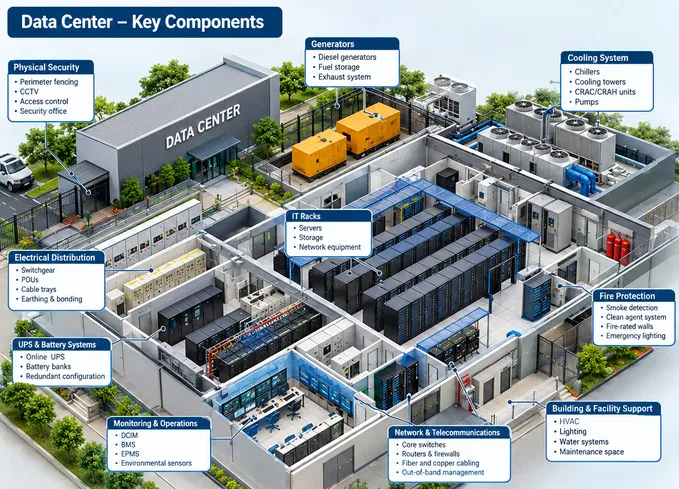 Figure : Data Center Architecture Components and Installation
3. Physical Security
Function: Physical security protects the data center building, IT infrastructure, employees, visitors, and critical equipment against unauthorized access, theft, vandalism, and physical threats.
Major elements include CCTV Surveillanc, Perimeter fencing, access control systems, security office, Biometric Systems, Security Guards, Instrusion Detection Systems, Visistor Management System, Security Alarms etc.
Operational importance:
- Prevents unauthorized physical access.
- Protects valuable IT assets and confidential information.
- Maintains audit trails of personnel access.
- Supports regulatory and compliance requirements.
4. Electrical Distribution System
Function: Electrical distribution infrastructure receives electrical power from utility sources, generators, and UPS systems and safely distributes it to IT equipment and facility systems.
Major elements include switchgear, transformers, power distribution units, remote power panels, busway systems, cable trays, circuit breakers, earthing & grounding, electrical bonding system, automatic transfer switch etc.
Operational importance:
- Ensures reliable power delivery to critical equipment.
- Protects infrastructure against electrical faults.
- Enables safe isolation and maintenance.
- Supports redundant electrical distribution architectures.
5. Generators
Function: Generators provide backup electrical power during utility power failures, ensuring that critical data center operations continue without interruption.
Major elements are diesel generators, fuel storage tanks, fuel transfer pumps, exhaust system, starting batteries, generator control panel etc.
Operational importance:
- Provides backup power during grid failures.
- Supports continuous operation of critical IT infrastructure.
- Reduces business downtime.
- Supports long-duration power backup when adequate fuel is available.
6. Cooling System (Mechanical Infrastructure)
Function: The cooling system removes heat generated by servers, storage devices, networking equipment, and electrical infrastructure to maintain safe operating temperatures and prevent equipment overheating.
Major elements are chillers, cooling towers, Computer Room Air Conditioning units, Computer Room Air Handling Units, Water Pumps (Chilled/Condenser), Cooling pipes & valves, Cooling Coils, Leak Detection Systems etc.
Operational importance:
- Prevents server overheating.
- Maintains suitable environmental conditions.
- Improves equipment reliability and lifespan.
- Reduces energy consumption through efficient cooling design.
7. Monitoring & Operations
Function: Monitoring and operations systems provide centralized visibility, monitoring, control, reporting, and management of critical data center infrastructure.
Major elements are DCIM (Data Center Infrastructure Management), BMS (Building Management System), EPMS (Electrical Power Monitoring System), Sensors (Environmental, Temperature & Humidity, Water Leakage detection), Power Meters, NOC (Network Operations Center) etc.
Operational importance:
- Enables proactive fault detection.
- Reduces downtime through early warning alerts.
- Provides real-time operational visibility.
- Supports preventive and predictive maintenance.
- Improves operational efficiency and reporting.
8. UPS & Battery Systems
Function: Uninterruptible Power Supply (UPS) systems provide continuous, conditioned electrical power to critical IT equipment during utility power disturbances or outages. They bridge the gap until generators start and stabilize.
Major elements are online UPS, Rectifier, Inverter, Static Bypass Switch, Battery Banks, Battery Management System (BMS), Battery Racks/Chargers, Battery Monitoring System, Redundant Configuration (provides backup UPS capacity or independent power paths to improve availability) etc.
Operational importance:
- Prevents interruption during short power outages.
- Protects equipment from voltage fluctuations and power disturbances.
- Provides sufficient backup time for generator startup.
- Improves power availability through redundancy.
9. Fire Protection System
Function: Fire protection systems detect fire or smoke at an early stage, alert personnel, suppress fires where appropriate, and protect people, equipment, and the building.
Major elements are smoke detection system, heat detectors, clean agent fire suppression, fire suppression cylinders, fire alarm control panel, fire rated walls, fire rated doors, fire dampers, fire extinguishers etc.
Operational importance:
- Enables early fire detection and warning.
- Protects personnel and critical infrastructure.
- Reduces the risk of fire spreading.
- Supports safe evacuation and business continuity.
10. Building & Facility Support
Function: Building and facility support infrastructure provides the physical environment, utilities, and operational facilities required for the safe, efficient, and continuous functioning of the data center.
Major elements are HVAC systems, lighting systems, water systems, Drainage Systems, Maintenance Space, Loading/Unloading area, raised flooring, roof waterproofing, plumbing systems, waste management, fire escape routes etc.
Operational importance:
- Provides a safe and functional working environment.
- Supports maintenance and repair activities.
- Protects critical equipment from external environmental conditions.
- Ensures the smooth operation of supporting utilities and building services.
Data Center Specifications & Installation Guide
Setting up a data center requires careful planning across infrastructure, power, cooling, networking, physical security, fire protection, and future scalability. The specifications will depend on whether you are building a small server room, an enterprise data center, a colocation facility or a hyperscale facility.
| Parameter | Initial planning specification |
|---|---|
| Facility type | Enterprise, colocation, edge, or hyperscale |
| Availability target | Define required uptime and acceptable maintenance windows |
| Rack capacity | Commonly 42U–48U racks; select based on equipment |
| Rack power density | 3–10 kW/rack for conventional IT; 10–30+ kW/rack for high-density workloads |
| Floor loading | Verify structural capacity for racks, batteries, UPS equipment, and cooling systems |
| Clear height | Set according to rack height, overhead cable trays, ducts, and fire suppression |
| Expansion provision | Reserve space and utility capacity for future racks and additional IT load |
| Standards | Consider applicable TIA-942, ISO/IEC 22237, ASHRAE guidance, and local building and electrical codes |
Summary
A well designed data center architecture is the foundation of a reliable, secure and scalable IT infrastructure. Careful planning, proper component selection and professional installation help ensure optimal performance, energy efficiency, business continuity and long term operational success.
Continue Learning Data Centers
- What is a Data Center : Key Advantages and Disadvantages
- AI Data Centers Architecture : Key Advantages and Disadvantages
Continue Learning Networking & Core Topologies (LAN, MAN, WAN)
- Networking Tutorial
- Switch vs Router: Networking Differences
- OSI vs TCP/IP Models
- IPv4 vs IPv6
- LAN, MAN, WAN Network Types Compared