
Network Sensing in 6G (ISAC): Working, Benefits & Challenges
Advertisement
Network sensing is a wireless paradigm standardized globally under the umbrella of Integrated Sensing and Communication (ISAC). It transforms cellular network infrastructure (base stations, Massive MIMO antennas, radio spectrum, edge compute, and backhaul) into a distributed environmental radar system. Officially recognized by the ITU-R as one of the six foundational usage scenarios of IMT-2030 (6G), network sensing enables mobile networks to perceive physical surroundings while simultaneously delivering data connectivity. At the physical layer, the wireless propagation channel serves two roles at once viz. communication and sensing.
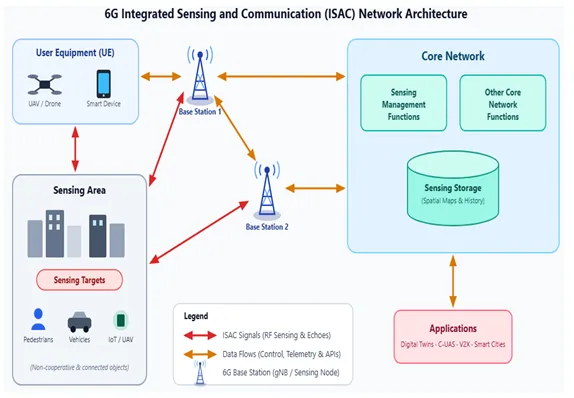 Image Courtesy : arxiv.org
ISAC (Integrated Sensing and Communication) allows a 6G wireless network to do two things at the same time:
- Communication: Transmit and receive data, just like today’s mobile networks.
- Sensing: Use radio signals to detect objects, determine their locations, measure their speed, and track their movements.
In simple terms, 6G base stations can work like both communication towers and radar systems, using radio signals to sense what is happening in their surroundings.
Crucially, network sensing can detect, localize and track non-cooperative, unconnected objects such as silent drones, pedestrians, vehicles or debris that carry no cellular modem and broadcast no radio identifier. The same is depicted in the figure.
Network Sensing Topologies
Depending on how transmitters and receivers are arranged, network sensing operates in three primary topologies as follows.
- Monostatic Sensing: A single base station transmits a signal and receives the reflected echoes itself.
- Bistatic Sensing: One node (e.g. a base station or user device) transmits while a geographically separate node receives the reflections.
- Multistatic Sensing: Multiple synchronized network nodes transmit and receive radio waves across a shared coverage area, pooling their observations to eliminate blind spots and compute 3D target motion.
How Network Sensing Works: Step by Step Process
Network sensing is not just an application running on a mobile phone. It involves the entire 6G network, including base stations, antennas, signal processing, AI and the network core.
- Service Request, Authorization & Node Selection: An application requests sensing in a specific area, and the network verifies the request and selects suitable base stations to monitor it.
- Coordinated Waveform Transmission: Selected base stations transmit radio signals for both communication and sensing while directing them toward the target area. Uses CP-OFDM waveforms and massive MIMO beams for this purpose.
- Target Reflection & Echo Reception: Radio signals hit objects such as drones, vehicles, and buildings, bounce back, and are received by the base stations.
- Precision Multi-Node Synchronization: Participating network nodes maintain tight time, frequency and phase alignment so echo arrival times and phase shifts across distributed sites can be compared accurately.
- Physical Parameter Extraction (Range, Doppler & Angle Processing): Base stations analyze the received reflected signals to determine three important parameters as follows.
- Time Delay → Distance: The time taken by the signal to travel to the object and return helps calculate its distance.
- Doppler Shift → Speed: Changes in the received signal frequency help estimate how fast the object is moving.
- Angle of Arrival → Direction: Multiple antennas help determine the direction from which the reflected signal arrives.
- Multisite Data Fusion & AI-Enabled Tracking: The network combines information from multiple base stations and uses AI to identify objects, determine their 3D locations, and continuously track their movements.
- Secure API Output & Operational Action: The network securely shares sensing information with external applications and uses it internally to improve wireless communication.
Benefits of Network Sensing
-
Reduced Infrastructure Cost: 6G can reuse existing base stations, antennas and network infrastructure for sensing, reducing the need to install expensive separate radar or LiDAR systems.
-
Detection of Unconnected Objects: 6G can detect and track physical objects, such as drones and vehicles, even if they do not transmit any signals or have an internet connection.
-
High Detection Accuracy: Using wider frequency bands and advanced antennas, 6G can detect objects more accurately and determine their distance and direction with greater precision. This has become possible as 6G supports upper mid-band (FR3), millimeter wave (mmWave) and sub-THz bands.
-
Reliable Detection Even When Signals Are Blocked: Multiple base stations can work together to detect and track objects even when one base station cannot directly see or receive signals from them.
-
Improved Wireless Communication: Sensing helps 6G predict obstacles, adjust signal beams and maintain better and more reliable wireless connections.
-
Better Privacy and New Revenue Opportunities: Since RF sensing can detect objects without capturing camera images, it can support privacy friendly applications while allowing operators to earn revenue by offering sensing services to businesses.
Challenges of Implementing Network Sensing in 6G Wireless
-
Communication vs. Sensing Trade-Off: 6G must balance the use of radio signals for communication and sensing without reducing internet speed or sensing accuracy.
-
Self Interference and Hardware Requirements: When a base station transmits and receives signals simultaneously, its own transmitted signals can interfere with the weak reflected signals, requiring advanced hardware and interference cancellation techniques.
-
Synchronization and Processing Requirements: Multiple base stations must be accurately synchronized. Moreover processing large amounts of sensing data in real time requires high computing power, energy and network capacity.
-
Detection Difficulties and Signal Loss: Detecting small objects, such as tiny drones, is difficult in environments with many obstacles and reflected signals, while high frequency signals can be easily weakened or blocked by rain, buildings and other obstacles.
-
Lack of Standardization and Compatibility: Common standards and interfaces for 6G sensing are still evolving, making it challenging for equipment from different manufacturers to work together smoothly.
-
Privacy and Security Risks: Since network sensing can detect people’s presence and movements, strong privacy protection, access control, and security measures are needed to prevent misuse of sensing information.
Summary
Network sensing via Integrated Sensing and Communication (ISAC) marks a fundamental shift in how wireless infrastructure operates; transforming 6G mobile networks from pure data transport pipes into a unified, programmable sensing fabric. ISAC is a key technology in 6G that enables wireless networks to perform both communication and sensing simultaneously using the same 6G network infrastructure and radio signals. It allows 6G base stations to detect, locate and track objects with the help of advanced antennas, signal processing, and AI, enabling applications such as drone detection, smart transportation and smart cities.
Continue Learning 6G Wireless Technology : Building Blocks of 6G
- 6G Wireless Network Basics Tutorial
- 6G Network Architecture & its interfaces
- Reconfigurable Intelligent Surfaces (RIS) in 6G
- AI Native in 6G Wireless Networks
- CoMP & RIS : Security in 6G
- RF Fingerprinting in 6G
- Physical Layer Security in 6G
- What is Autoencoder in 6G
- What is OAM Multiplexing in 6G
- What is OTFS Waveform in 6G
- MAC Layer Security Concepts in 6G