
What is WDM : Wavelength Division Multiplexing Advantages and Disadvantages
Advertisement
Wavelength Division Multiplexing (WDM) is an optical communication technique that transmits multiple data channels through a single optical fiber using different wavelengths. Its advantages include increased bandwidth and efficient fiber utilization, whereas its disadvantages include higher equipment costs and greater system complexity.
WDM and its comparison with TDM
WDM stands for Wavelength Division Multiplexing. It’s an optical multiplexing technique that utilizes different frequencies at varying wavelengths to transmit data independently over multiple channels.
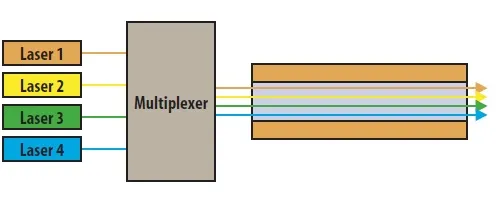
WDM assigns unique frequencies of light, each with a specific bandwidth, to different optical signals. These multiplexed wavelengths are then transmitted over a single fiber. At the demultiplexer end, these signals are separated using a tuner set to the desired bandwidth.
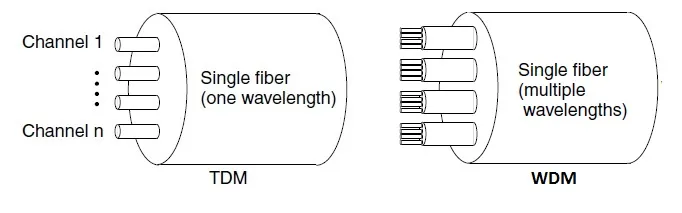
Unlike Time Division Multiplexing (TDM), in WDM, all signals arrive simultaneously but with different wavelengths.
Benefits (Advantages) of WDM
- Full Duplex Transmission: WDM enables simultaneous two-way communication.
- Easier to Reconfigure: The system is relatively easy to adjust and adapt to changing needs.
- Reliable Optical Components: WDM systems often use similar and dependable optical components.
- Higher Bandwidth: WDM offers a significant increase in bandwidth capacity.
- Simple Implementation: The technology is relatively straightforward to implement.
- High Security: WDM provides enhanced data security.
Drawbacks (Disadvantages) of WDM
- Signal Separation: Signals must be sufficiently spaced apart in frequency to avoid interference.
- Limited to Point-to-Point Circuits: Light waves carrying WDM signals are typically restricted to two-point connections.
- Scalability Concerns: Scaling the network can be challenging. In PON (Passive Optical Network) implementations, the OLT (Optical Line Termination) needs a transmitter array with one transmitter per ONU (Optical Network Unit). Adding a new ONU can be problematic unless transmitters were provisioned in advance.
- Wavelength Specific Lasers: Each ONU must have a laser that operates at a specific wavelength.
- Increased System Cost: The cost of the system increases as more optical components are added.
- (WDM in PON): Inefficiency in bandwidth utilization, difficulty in wavelength tuning, and challenges in cascaded topologies are potential issues.
Summary
WDM technology maximizes optical fiber capacity by supporting high-speed, high-bandwidth communication for modern telecommunication and data center networks.