
What is Circular Polarization : Advantages and Disadvantages
Advertisement
Circular polarization is an electromagnetic wave polarization technique in which the electric field rotates as the wave propagates. It is widely used in satellite, GPS, RFID, and wireless communication systems. Advantages include reduced orientation sensitivity, while disadvantages include higher antenna complexity and lower gain compared to some linear antennas.
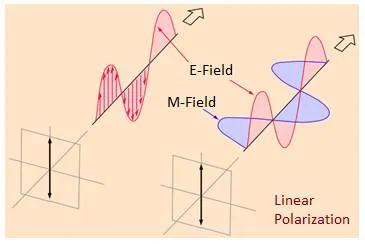
Polarization refers to the directional aspects of the electric field (E-field) of electromagnetic (EM) radio waves. It enables frequency reuse, enhancing satellite bandwidth capacity by allocating the same frequency at different polarizations (i.e., linear and circular).
RHCP Vs LHCP
Circular polarization occurs when the E-field radiates energy in both the horizontal and vertical planes, as well as all planes in between. In this polarization, the electric field has two linear components that are perpendicular to each other, with equal amplitude and a 90-degree phase difference.
The resulting E-field rotates in a circle around the direction of propagation. Based on the direction of rotation, there are two types:
- RHCP (Right-Hand Circular Polarization)
- LHCP (Left-Hand Circular Polarization)
Circularly polarized light signals can be generated by passing a linearly polarized light signal through a quarter-wave plate (λ/4) at an angle of 45 degrees to the optical axis of the plate.
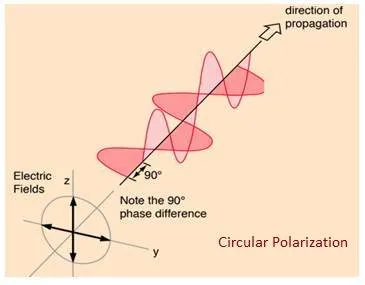
- RHCP (Right-Hand Circular Polarization): In this type, the electric field rotates clockwise as seen by an observer towards whom the wave is moving. This type is shown in the figure above.
- LHCP (Left-Hand Circular Polarization): In this type, the electric field rotates counterclockwise as seen by an observer towards whom the wave is moving.
Advantages of Circular Polarization
- No polarization adjustment is required, as it is fixed using an OMT (Orthomode Transducer).
- There is less chance of cross-polarization interference.
- RFID readers do not have to be on the same plane or similar heights as RFID tags, unlike linear polarization RFID readers.
- RFID readers do not require knowledge of the tag orientation, unlike linearly polarized RFID readers. Therefore, it’s used for applications where the orientation of RFID tags is unknown when reading data.
Disadvantages of Circular Polarization
- It increases the cost of the antenna system.
- It offers slightly lower cross-polarization isolation.
- It offers a shorter read range for RFID readers compared to linear polarization.
Summary
Circular polarization improves communication reliability in changing orientations. Advantages include polarization flexibility, while disadvantages include increased antenna complexity and potential signal loss.