
Ground Wave vs. Sky Wave : Advantages, Disadvantages, Differences
Advertisement
Ground waves and sky waves are radio propagation modes used for long distance wireless communication. Ground waves travel along the Earth’s surface and are suitable for lower frequencies, while sky waves are reflected by the ionosphere to cover greater distances. Each method offers unique advantages and disadvantages related to range, reliability, and frequency dependence.
Introduction : In radio communication, signal propagation can occur through various modes depending on frequency, terrain, and atmospheric conditions. Two fundamental types of propagation are Ground Wave and Sky Wave. Ground wave travels along the Earth’s surface and is commonly used for low frequency communications, while sky wave reflects off the ionosphere, enabling long distance transmission at higher frequencies
Ground Wave Propagation
Ground waves follow the Earth’s curvature, allowing them to propagate over considerable distances. This type of propagation is typically used at frequencies below 2 MHz. A common example is AM radio.
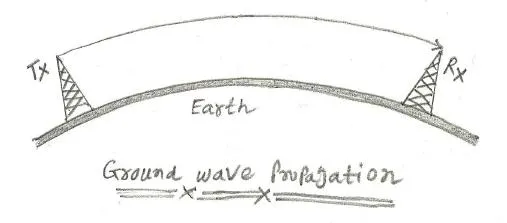
Figure 1: Ground wave propagation
Advantages of Ground Wave Propagation
- Reduced Interference: Lower frequencies are less susceptible to interference, mainly experiencing atmospheric noise.
- Longer Distance Coverage: Absorption of electromagnetic waves is less at lower frequencies, enabling greater range. However, path loss increases with distance, requiring an optimal separation between the transmitter (Tx) and receiver (Rx).
- Vertical Polarization: Ground waves are vertically polarized to prevent short circuits of the electric field (E) component.
Disadvantages of Ground Wave Propagation
- Polarization Sensitivity: If the polarization is affected, the E-field components can be short-circuited by the ground.
- Distance Limitations: The distance between the transmitter and receiver antennas should not be excessively large. Otherwise, signal strength diminishes due to ground and atmospheric absorption, hindering communication.
- Cost: Repeaters may be necessary to maintain signal strength over longer distances, increasing the overall system cost.
Sky Wave Propagation
Sky waves rely on reflection from the ionosphere, an ionized layer in the atmosphere. Signals can travel long distances through multiple “hops,” bouncing back and forth between the ionosphere and the Earth’s surface. Shortwave (SW) radio is a typical application.
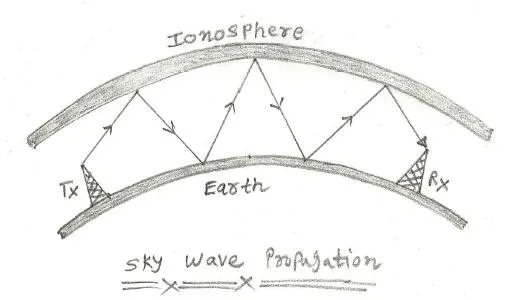
Figure 2: Sky wave propagation
Sky wave propagation occurs at frequencies ranging from 2 MHz to 30 MHz.
Advantages of Sky Wave Propagation
- Simplicity: Sky wave propagation is a relatively simple mode of transmission, leveraging the reflective properties of the ionosphere.
- Continuous Support: It can provide continuous communication support.
Disadvantages of Sky Wave Propagation
- Distance Variability: The position of the ionosphere varies between day and night. During the day, the ionosphere is closer and during the night the ionosphere is far, leading to differing propagation distances.
- Signal Strength Reduction: Signals often undergo multiple hops, which can significantly reduce signal strength, especially over long distances between the transmitter and receiver antennas.
Summary
Ground waves and sky waves are key radio propagation techniques for wireless communication. Ground waves provide reliable local coverage, while sky waves enable long distance communication but depend on ionospheric conditions.