
What is Memristor in Memory Industry : Top Manufacturers
Advertisement
A memristor is an advanced electronic component that combines memory and resistance properties, allowing it to retain information even when power is removed. Considered a promising next-generation memory technology, memristors offer high storage density, low power consumption, fast switching, and potential applications in AI computing and neuromorphic systems.
As demand grows for more efficient, high performance memory solutions, leading manufacturers are developing advanced memristor technologies. The popular manufacturers driving innovation in the memory industry include Knowm Inc., Micron Technology, Rambus, SK hynix Inc., SanDisk, and HP.
Introduction to Memristors
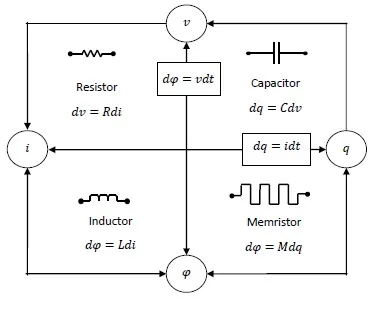
We are familiar with three basic circuit elements: resistors, capacitors, and inductors. These elements establish relationships between any two of the four fundamental circuit variables: current (i), voltage (v), charge (q), and flux (Φ).
- Resistor: Relates voltage and current.
- Capacitor: Relates voltage and charge.
- Inductor: Relates current and flux.
The fourth element, the memristor, provides a relationship between charge and magnetic flux. The term “memristor” is derived from “memory resistor.” It’s a passive two-terminal device where magnetic flux is related to the amount of electric charge passed through it.
A typical memristor consists of three layers: metal-insulator-metal. The top and bottom contacts are metal, with an insulator in between, typically made of a resistive switching material like transition metal oxides such as , , , , , , , , etc. Platinum (Pt) and Silver (Ag) often meet the technical requirements for use as top electrodes, while Indium Tin Oxide (ITO) is frequently used as a bottom electrode.
Different materials are used in various memristor implementations. Memristors are widely used in analog and digital circuit designs. Applications include memristor-based image encryption, memristor-based Op-amps, memristor-based crossbar structures, memristor-based oscillators, and flexible non-volatile memristors.
Memristor Manufacturers
The following table lists some of the popular manufacturers of memristors:
| Manufacturers | Description |
|---|---|
| Knowm Inc. | Develops SDC (Self-Directed Channel) memristor Ion-conducting devices which uses chalcogenide glass and Ag or Cu metals. The company has produced memristor crossbars along with resistance programming. |
| Micron Technology, Inc. | The company has acquired Elpida Memory to enter into the business of ReRAM and other memory products. |
| Rambus Incorporated | The company is one among the key players in the Ionic Film Memristor market. |
| SK hynix Inc. and HP | They are working together to develop ReRAM (Resistive Random Access Memory) memristor designs. |
| SanDisk and HP | Both companies are working to bring memristor technology to the market. |
Conclusion
A memristor is a non-volatile memory component capable of storing data through resistance changes. Manufacturers are developing memristor technologies for next-generation memory, artificial intelligence, neuromorphic computing, and high-density storage applications.