
What is Direct RF Data Converter SoC : Top Manufacturers
Advertisement
A Direct RF Data Converter SoC (System on Chip) is an integrated semiconductor solution that combines high speed analog to digital converters (ADCs), digital to analog converters (DACs), programmable processing and RF signal processing capabilities on a single chip. It enables direct sampling and generation of radio frequency signals, simplifying system architecture for wireless communications, radar, aerospace, defense and test applications.
Introduction : The rapid evolution of wireless communications, radar, aerospace, and test & measurement systems has driven a fundamental shift in radio frequency (RF) system architectures. Traditional RF designs relied heavily on analog front end components such as mixers, filters and intermediate frequency (IF) stages, which added complexity, power consumption and cost. Today, Direct RF data converter System on Chip (SoC) platforms are transforming RF system design by integrating high speed analog to digital converters (ADCs), digital to analog converters (DACs), programmable logic and processing subsystems into a single device. Leading semiconductor companies are now competing to deliver highly integrated Direct RF SoCs that enable software defined radios, massive MIMO, advanced radar systems and next generation communication infrastructure.
Direct RF Data Conversion System
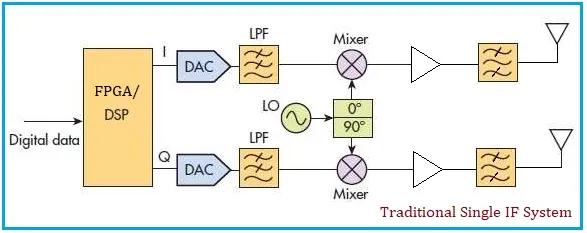
For decades, heterodyne architecture was used in RF engineering for up conversion and down conversion of RF signals. To process a high frequency signal, engineers had to rely on multiple stages of analog “mixing” to step the signal down to an Intermediate Frequency (IF) before it could be digitized. The figure-1 depicts single stage conversion system using single RF mixer and necessary other components such as mixers, LOs and specialized filters (IF or RF). Following are design drawbacks of such architectures.
- Take up massive amounts of PCB real estate.
- Each analog stage introduces noise, phase error and potential interference.
- LOs (Local Oscillators) can leak signals through mixers. This requires heavy metal shielding to prevent cross-talk.
By using high speed ADCs (Analog-to-Digital Converters) that sample at Gigasamples per second (GSPS), the signal is digitized directly at or near the carrier frequency. This effectively eliminated the need of mixer and the LO distribution network. This moves the heavy lifting from hardware components to digital algorithms.
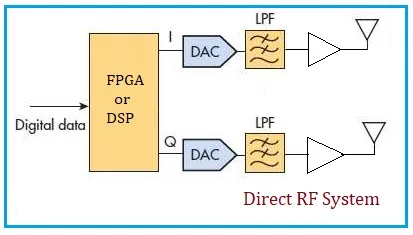
Following are the benefits of direct RF conversion systems.
- By removing the analog front-end, a system that once required multiple circuit boards can now be condensed into a single RF System on Chip (RFSoC) or a compact Mixed-Signal Front-End (MxFE).
- It shifts architecture from hardware defined to software defined functionality. The “filtering” and “down-conversion” happen in the digital domain (Digital Down Conversion or DDC).
- Simplifies calibration and reproducibility.
Direct RF Data Converter SoC providers
Analog Devices (ADI): The company is highlighted for its MxFE (Mixed Signal Front End) and the high performance Apollo series. These are designed for multi-band operation and high agile bandwidth.
AMD (Xilinx) : The company is the industry leader for integrating these converters directly onto a programmable logic fabric (FPGA), creating a true “System on Chip” for RF.
Altera (Intel): The company is pushing the boundaries of sampling rates, aiming for ultra wideband (UWB) applications that reach into the millimeter wave range.
Texas Instruments (TI): The company focuses on high channel density and power efficiency, which is critical for massive MIMO and 5G/6G infrastructure.
Following table mentions popular part numbers with their unique features.
| Manufacturer | Notable part number | Top ADC Rate | Key strength |
|---|---|---|---|
| Altera | Stratix 10 | 64 GSPS | Pure Bandwidth (up to 36 GHz) |
| Analog Devices | Apollo AD9084 | 20 GSPS | Best Dynamic Range/Performance |
| AMD | Versal VR1652 | 32 GSPS | Integration with FPGA Logic |
| Texas Instruments | AFE8192 | 6 GSPS | High Channel Count (16/16) |
Summary
A Direct RF Data Converter SoC is a system on chip that integrates RF data converters, signal processing, and programmable logic to directly sample and generate radio frequency signals. Leading manufacturers offer these advanced SoCs for 5G networks, radar systems, aerospace, defense electronics, software defined radio and high performance communication applications.