
8-VSB Modulation Explained
Advertisement
This page describes 8 level VSB modulation.
VSB is the short form of Vestigial Sideband Amplitude Modulation. It’s a modulation scheme commonly used in Digital TV. In this modulation technique, the carrier signal is suppressed, and only the upper sideband is transmitted.
The serial data is fed into a Digital-to-Analog Converter (DAC). The DAC converts the serial data, processing it in groups of 3 bits at a time, into a discrete voltage level.
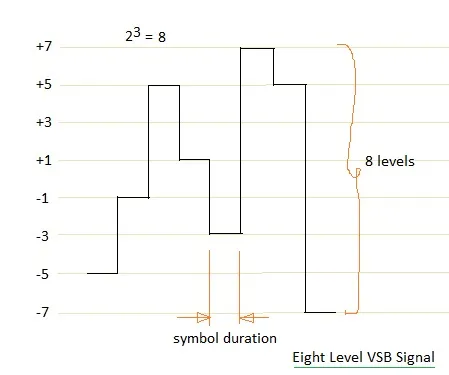
The system encodes 3 bits per symbol, which effectively increases the data rate within the channel.
The example is depicted in the figure above. As shown, each 3-bit group is converted into a relative voltage level: -7, -5, -3, -1, +1, +3, +5, or +7.
This resulting signal is then used to modulate the RF carrier. This process results in a symbol rate of approximately 10800 symbols per second.
This translates into a data rate of 3 bits/symbol * 10800 symbols/second = 32.4 Mbps.
Continue Learning Modulation Types
- AM Vs. FM Vs. PM : Difference between Analog Modulation Techniques
- ASK Vs. FSK Vs. PSK : Difference between Digital Modulation Techniques
- PAM Vs. PWM Vs. PPM : Difference between Pulse Modulation Techniques
- BPSK Vs. QPSK : Key Differences
- 16-QAM Vs. 64-QAM Vs. 256-QAM : Key Differences
- 512-QAM Vs. 1024-QAM Vs. 2048-QAM Vs. 4096-QAM
- 4096QAM Modulation Used in Wi-Fi 7
- MSK Vs. GMSK : Modulation Technique used in GSM
- LORa Modulation Used in LoRaWAN
- 10% ASK & 100% ASK Modulation used in NFC
- OOK Vs. VPPM Vs. CSK : Visible Light Communication (VLC) Modulation Techniques
- QPSK Vs. OQPSK Vs. PI/4 QPSK
- PAM4 Modulation Used in Gigabit Ethernet
- CCK Vs. DSSS Vs. OFDM Used in WLAN (Wi-Fi) Standards