
What is X10 Protocol: Advantages and Disadvantages
Advertisement
The X10 protocol is a home automation communication standard that controls electrical devices by transmitting digital signals over existing power lines or wireless links. Its advantages include low installation cost and easy deployment, whereas its disadvantages include slow communication speed, limited security, and susceptibility to electrical noise.
X10 in Home Automation and its protocol fields
Introduction: The X10 protocol has gained popularity for home automation within the Internet of Things (IoT). This powerline signaling technology leverages your home’s existing electrical wiring as its transport medium – the physical layer. X10 devices are easy to interface, plugging directly into wall sockets just like regular appliances like lamps, fans, and air conditioners.
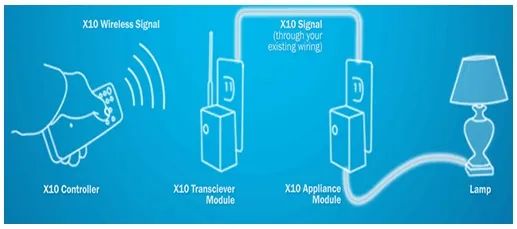 X10 Home Automation
A remote controller can be used to turn lights and other X10 appliances on and off. Depending on a consumer’s budget, an appropriate X10 network can be installed to meet their specific needs.
X10 uses On-Off Keying (OOK) modulation and Manchester encoding to map binary information onto the X10 signal waveforms. An X10 packet consists of a Start Code (4 bits), a House Code (8 bits), and a Key Code (10 bits). This packet can be transmitted using two bursts in a row (for the start symbol), followed by a one symbol, followed by nine data symbols.
 X10 bit field
Another home automation technology called INSTEON is often used as a successor to X10.
Benefits or Advantages of the X10 Protocol for Home Automation
- Easy Installation: It utilizes existing electrical wiring as the physical layer for data transmission and reception, making installation quick and straightforward.
- Cost-Effective: Since no new wiring is required, it’s a less expensive home automation solution.
- Simple Setup: Installation is simple enough that specialized professionals or engineers aren’t necessary.
- Simple Protocol: The protocol is very easy to implement and supports 256 unique X10 devices on a single powerline.
- IoT Friendly: Its low overhead has made it popular in the IoT (Internet of Things) for home automation.
- Consumer Appeal: X10 has become popular with consumers who want home automation technology to simplify their lives.
Drawbacks or Disadvantages of the X10 Protocol for Home Automation
- Low Data Rate: The data rate supported by the X10 protocol is very low, on the order of bits per second. This limits the technology to primarily ON/OFF control of X10 devices.
- Susceptible to Interference: Because it uses powerlines for operation, other electrical devices can cause interference, leading to malfunctioning of X10 devices.
- Not Suitable for Safety Devices: X10 devices are not recommended for use as safety-critical devices.
- Delay in Transmission: Packet transmission from the controller to the X10 end device experiences a delay, approximately 1 second for a 100-bit packet.
- Lack of Advanced Features: Data acknowledgement and security features are not supported by the X10 protocol.
Summary
The X10 protocol introduced practical home automation by enabling affordable remote control of household devices using existing electrical wiring.