
WiFi 8: Exploring the Next Generation of Wireless Networking
Advertisement
As of 2024, while the IEEE 802.11be task group is nearing completion of the WiFi 7 standard, the IEEE 802.11 working group has already begun exploring the next generation: WiFi 8. This new standard, officially known as IEEE 802.11bn, aims to push the boundaries of wireless performance and reliability.
The Ultra High Reliability (UHR) study group is actively involved in preparing a Project Authorization Request (PAR) for WiFi 8. The 802.11 working group will be examining physical layer and MAC layer technologies to:
- Improve the reliability of WLAN connectivity
- Reduce latencies
- Increase manageability
- Increase throughput (including at different SNR levels)
- Reduce device-level power consumption
The combined use of multi-link operation and spatial-domain multi-AP coordination is being considered as a key factor in achieving ultra-high reliability within WiFi 8 networks.
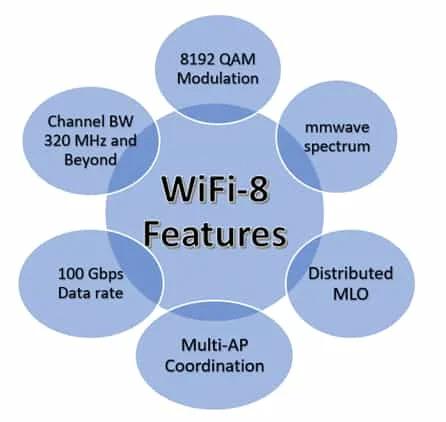
Key Features Planned for WiFi 8
The following features are planned for incorporation into WiFi 8 technology-based devices:
- Integrated mm-wave operations: Leveraging the higher frequencies of millimeter wave technology.
- Distributed MLO (Multi-Link Operation): Enhancing connectivity by utilizing multiple links simultaneously.
- Multi-AP Coordination: Coordinating multiple access points for improved network efficiency.
- Channel Bandwidth Up to 320 MHz and above: Wider channels for increased data capacity.
- 8K QAM Modulation Scheme: Higher-order modulation for greater data density.
- Designed for Specific Applications: Tailored to meet the needs of AR/XR/VR, smart home appliances, and gaming.
Benefits and Advantages of WiFi 8
WiFi 8 offers several key advantages:
- Seamless Connectivity: Achieved through Distributed Multi-Link Operation (MLO).
- Ending Primary channel issue: Improving Spectrum efficiency In legacy Wi-Fi, if the “Primary 20 MHz” channel was busy, the entire 160 MHz or 320 MHz band sat idle. Wi-Fi 8 uses Non-primary Channel Access (NPCA), allowing devices to dynamically switch to a different primary channel if the main one is congested. This leads to much better spectrum efficiency in crowded apartment buildings or offices.
- Controlled Delay: AP coordination helps to minimize worst case delay.
- Higher Data Transfer Rate: Higher channel bandwidth and 8K QAM OFDMA modulation could enable data transfer rates of about 100 Gbps, a significant improvement over WiFi 7.
- Improved Reliability: Reduces latencies, enhancing the overall reliability of WLAN connectivity. Wi-Fi 8 uses Priority EDCA (P-EDCA) and Coordinated TDMA to “reserve” airtime for time-sensitive traffic.
- Balanced Link Budget (Better Uplink Range): Wi-Fi 8 introduces Distributed-tone Resource Units (DRU). By scattering signal tones across a wider bandwidth, devices can transmit at much higher power levels while staying within legal limits. This significantly extends the range of the connection, particularly for the uplink.
Comparison : Wi-Fi 8 vs. previous generations
| Feature | Legacy (Wi-Fi 5/6) | Wi-Fi 7 (802.11be) | Wi-Fi 8 (802.11bn) | Benefits of Wi-Fi 8 |
|---|---|---|---|---|
| Primary Goal | Efficiency | Efficiency | Reliability (UHR) | Stable performance in high-density areas. |
| Uplink Power | Limited by PSD | Limited by PSD | DRU Spreading | Massive range boost for weak devices. |
| Latency | Best Effort | Reduced Latency | P-EDCA & Co-RTWT | Predictable, ultra-low latency for VR/Gaming. |
| Spectrum Use | Restricted by Primary | Puncturing support | NPCA & MAPC | Flexible use of every free MHz. |
| Roaming | Slow (Re-association) | Multi-Link (MLO) | Seamless Domain | Zero drop handovers between APs. |
Conclusion
WiFi 8, or IEEE 802.11bn, represents a major step forward in wireless networking, offering both significant benefits and key new features. Wi-Fi 8 isn’t just about being faster; it’s about being smarter. It transforms Wi-Fi from a “best-effort” consumer convenience into a professional grade infrastructure that delivers consistent, ultra reliable performance regardless of how many people are online or how far you are from the router. Overall, WiFi 8 promises to be a substantial leap forward in wireless communication, providing a more robust and reliable connectivity solution for the evolving digital landscape.
Advertisement


