
What is MU-MIMO in 802.11ax WLAN : Multi-User MIMO
Advertisement
MU-MIMO (Multi-User Multiple Input Multiple Output) in 802.11ax allows a Wi-Fi access point to communicate with multiple devices simultaneously using multiple antennas. This technology improves network capacity, increases throughput, reduces congestion and enhances performance in high density wireless environments such as offices and public venues. This page describes MU-MIMO (Multi-User MIMO) as defined in IEEE 802.11ax standard and explains benefits of MU-MIMO.
Introduction
MU-MIMO was first introduced in IEEE 802.11ac. It enables the transmission of multiple frames to different receivers simultaneously on the same channel. This is achieved by using multiple spatial streams (SSs), leading to higher efficiency.
MU-MIMO leverages unique modulated complex data streams to communicate with multiple clients concurrently, employing a spatial diversity technique. Initially, it was only implemented in the downlink direction in 802.11ac. However, in 802.11ax, MU-MIMO is implemented in both the downlink and uplink directions.
What is MU-MIMO in WLAN 802.11ax?
- As illustrated in the image below, MU-MIMO utilizes different spatial streams for communication between multiple client devices.
- It employs beamforming techniques to establish unique connections with the desired clients.
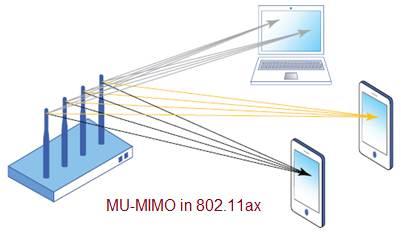
Image Courtesy: Aerohive Networks
- The minimum Resource Unit (RU) size required to use MU-MIMO in 802.11ax is 106 subcarriers or higher.
- IEEE 802.11ax technology integrates both MU-MIMO and MU-OFDMA. OFDMA provides multiuser access by dividing a single channel into multiple subcarriers, while MU-MIMO offers multiuser access by using different spatial streams.
- MU-MIMO is particularly well-suited for scenarios with very low client density and high bandwidth applications where large packets are used for transmission.
Benefits and Advantages of MU-MIMO
- MU-MIMO allows for the simultaneous use of up to 8 clients.
- It provides significantly higher data throughput.
Advertisement


