
What is 802.11ac Wi-Fi 5 : Key 5 Advantages and Disadvantages
Advertisement
802.11ac, commonly known as Wi-Fi 5, is a wireless networking standard that operates primarily in the 5 GHz band and offers faster speeds than earlier Wi-Fi generations. Advantages include high throughput and improved performance, while disadvantages include shorter range and reduced compatibility with some legacy devices.
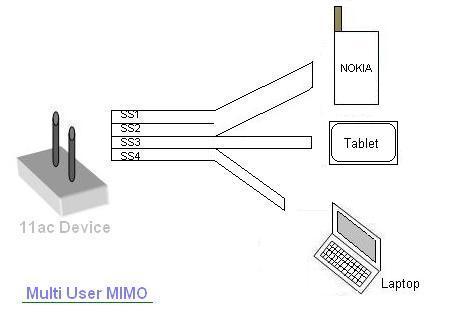
Introduction: 802.11ac is a Wi-Fi standard that evolved from its predecessor IEEE 802.11n. It was designed to provide faster data rates (in the Gigabit per second range) or wireless devices, primarily for WLAN applications. Unlike earlier 802.11 standards which were built for single user operation, 802.11ac introduced the concept of multi-user MIMO. Beamforming technology was also included to improve coverage by focusing the signal towards specific areas.
Key features of 802.11ac
- Frequency Bands: 5 GHz
- Channel Bandwidths: 20 MHz, 40 MHz, 80+80 MHz, 160 MHz
- FFT sizes: 64, 128, 256, 512
- Subcarrier spacing: 312.5 KHz
- OFDM symbol duration: 3.2µs + 0.8/0.4 µs CP
- Modulation scheme (highest): 256 QAM
- Data rates: 433 Mbits/sec (with 80 MHz and 1 Spatial Stream(SS)), 6.933 Gbits/sec (with 160MHz, 8 SS)
Advantages of 802.11ac wifi
Following are some of the benefits of 802.11ac WiFi.
- Gigabit Speeds: Offers speeds up to three times faster than 802.11n.
- Improved Coverage: Provides whole-home coverage with fewer dead spots.
- Wider Channel Bandwidths: Utilizes wider channel bandwidths (80 MHz and 160 MHz).
- Advanced Modulation: Employs complex modulation schemes up to 256-QAM, resulting in a 33% increase in data rates.
- Multiple Spatial Streams: Uses multiple spatial streams, delivering an N-fold increase in efficiency.
- Multi-User MIMO (MU-MIMO): Supports Multi-User MIMO, enabling simultaneous downlink transmission to single-stream clients, which improves overall network capacity.
Disadvantages of 802.11ac Wi-Fi
Following are some of the drawbacks of 802.11ac Wi-Fi.
- No 2.4 GHz Support: Does not support the 2.4 GHz frequency band.
- Limited Symbol Duration Support: Only supports symbol durations with shorter lengths.
- No 1024-QAM: Higher modulation schemes, such as 1024-QAM, are not supported.
- Contention-Based Uplink: Uplink access is contention-based, which can lead to collisions, backoffs, and a reduction in effective throughput when many devices are connected.
- Limited Uplink MU-MIMO: MU-MIMO is not supported in the uplink. In 802.11ac Wave 2, MU-MIMO is only used in the downlink with 4 simultaneous streams.
Summary
Wi-Fi 5 (802.11ac) delivers high speed wireless connectivity using the 5 GHz band. Advantages include improved performance, while disadvantages include shorter coverage compared to lower frequency Wi-Fi standards.
Advertisement


