
What is WiMAX : Architecture, Advantages and Disadvantages
Advertisement
WiMAX (Worldwide Interoperability for Microwave Access) is a broadband wireless communication technology designed to provide high speed Internet access over large geographical areas. Its advantages include wide coverage and high data throughput, while its disadvantages include spectrum licensing requirements and competition from newer wireless technologies.
WiMAX Network Architecture
WiMAX is an IP-based wireless broadband access technology. It offers performance similar to Wi-Fi networks but with the coverage and Quality of Service (QoS) capabilities of cellular networks.
WiMAX can provide broadband wireless access up to 30 miles for fixed stations and 3 to 10 miles for mobile stations.
As illustrated below, a WiMAX network consists of two primary elements:
- WiMAX Base Station (BS)
- WiMAX Subscriber Stations (SSs)
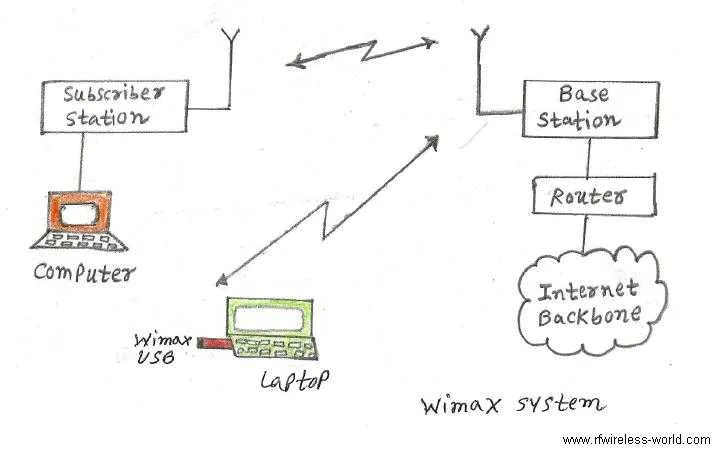
The WiMAX BS provides coverage to a large area (approximately 3000 square miles) and supports a significant number of SSs. It is also commonly referred to as a WiMAX tower.
A WiMAX SS is a small device, about the size of a box or a PCMCIA card. It can be connected to a desktop or laptop computer.
WiMAX supports various frequency bands and comes in two main versions:
- Fixed WiMAX: Supports fixed subscribers.
- Mobile WiMAX: Supports mobile subscribers.
The PHY and MAC layer specifications for WiMAX are defined in the IEEE 802.16 series of standards.
Advantages of WiMAX
- High-Speed Data Transfer: Supports very high-speed voice and data transfer over longer distances.
- Large User Capacity: A single WiMAX BS can serve hundreds of users.
- Cost-Effective Alternative: Considered a cheaper alternative to broadband wired technologies like ADSL and Cable modem.
- High Speed: Higher data speeds can be achieved.
- Extended Coverage and Cellular-like Performance: Mobile WiMAX offers a higher coverage range and cellular-like performance.
Disadvantages of WiMAX
- Line of Sight (LOS) Requirement: Subscribers located far from the WiMAX BS require a Line of Sight (LOS) connection.
- Weather Sensitivity: Bad weather conditions, such as rain, can interrupt the WiMAX signal and cause a loss of connection.
- Power Consumption: WiMAX is a power-consuming technology and requires significant electrical support.
- High Initial Cost: Requires a high initial investment, as it’s not backward compatible with existing wireless cellular technologies. New WiMAX BSs and towers must be installed, which leads to higher upfront costs and ongoing operational expenses due to the need for skilled manpower.
Summary
WiMAX played a significant role in broadband wireless access by delivering high-speed connectivity across metropolitan and rural regions.
Continue learning WiMAX Technology
- WiMAX Basics Tutorial
- WiMAX Network Architecture
- Wimax Network Entry Procedure
- WiMAX Frame Structure
- Wimax Protocol Stack
- WiMAX Physical Layer
- WiMAX MAC Layer