
What is WiMAX : Architecture, Features & Applications
Advertisement
WiMAX is a broadband wireless communication technology based on the IEEE 802.16 standard. Designed for long range internet access, WiMAX provides high speed data connectivity, wide area coverage, and support for fixed and mobile broadband services in urban, suburban and rural deployment scenarios.
Understanding WiMAX
WiMAX is a technology designed to deliver broadband data connections to users, similar to DSL. The key benefit is its ability to serve both fixed and mobile users. This flexibility is achieved through two primary types of WiMAX:
- Fixed WiMAX: Primarily intended for users at fixed locations.
- Mobile WiMAX: Designed for users on the move, but can also be used for fixed locations. Fixed WiMAX cannot provide mobile services, however.
The core difference lies in the underlying technology: Fixed WiMAX relies on OFDM (Orthogonal Frequency-Division Multiplexing), while Mobile WiMAX utilizes OFDMA (Orthogonal Frequency-Division Multiple Access). These technologies have been developed by IEEE and the standards are 802.16-2004, 802.16e-2005 and latest release is 802.16e-2009.
WiMAX operates across different RF bands, typically ranging from 3 to 3.6GHz, 2.3 to 2.4GHz, and 2.5 to 2.7GHz, depending on country-specific regulations. Manufacturers have developed RF equipment to support these diverse bands. Understanding the evolution of WiMAX within the IEEE standards is crucial to grasping its full capabilities.
WiMAX vs. WiFi: Coverage
WiMAX offers a significantly greater coverage area compared to WiFi (WLAN).
- WiFi Range: Approximately 30 meters.
- WiMAX Range: Up to 50 kilometers in radius.
WiMAX can theoretically support data rates of around 70Mbps using higher modulation schemes like QAM (Quadrature Amplitude Modulation).
WiMAX Architecture
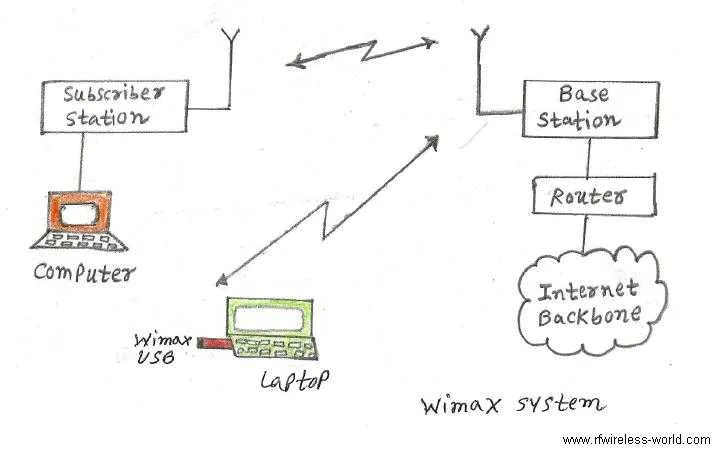
The diagram above illustrates the basic components of a WiMAX system:
- Base Station (BS): Connects to the internet backbone through an ASN-GW (Access Service Network Gateway).
- Subscriber Premises Equipment (SPE): Includes a modem and antenna.
The WiMAX subscriber modem connects either directly to a desktop computer or to a LAN (Local Area Network) or router. This allows for multiple devices (laptops, mobile phones, tablets) to simultaneously connect to the WiMAX data connection. In mobile WiMAX, user equipment like USB dongles, mobile phones, and tablets can directly connect to the base station for internet access.
Continue learning WiMAX Technology
- WiMAX Basics Tutorial
- WiMAX Network Architecture
- Wimax Network Entry Procedure
- WiMAX Frame Structure
- Wimax Protocol Stack
- WiMAX Physical Layer
- WiMAX MAC Layer