
What is VSAT: 5-10 Advantages and Disadvantages
Advertisement
VSAT (Very Small Aperture Terminal) is a satellite communication system that provides broadband connectivity through compact ground antennas for remote and distributed locations. Its advantages include wide area coverage and reliable connectivity, whereas its disadvantages include higher latency and installation costs compared to terrestrial communication networks.
VSAT (Very Small Aperture Terminal) technology is vital in satellite communication, offering reliable internet and data connectivity in remote areas where traditional broadband services might not be available. It’s widely used in industries like telecommunications, maritime, and government services, becoming essential for ensuring communication and data transmission across geographically isolated regions.
VSAT System Block Diagram and working
The term VSAT requires a geostationary (GEO) satellite in space to provide service. Depending on the application, VSATs are used at various frequency bands, including L Band, C Band, Extended C Band, Ku Band, and Ka Band.
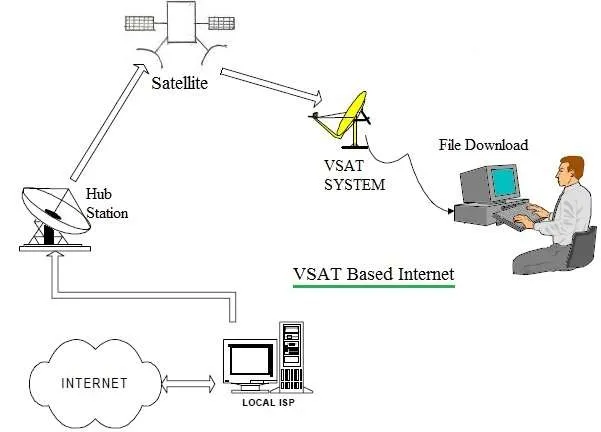
Figure 1: Typical block diagram of a VSAT terminal
There are two main VSAT network topologies: Star and Mesh.
- Star Topology: VSAT-to-VSAT communication happens through a Hub Station and the satellite in two hops.
- Mesh Topology: VSAT-to-VSAT communication happens directly, without needing a central Hub Station.
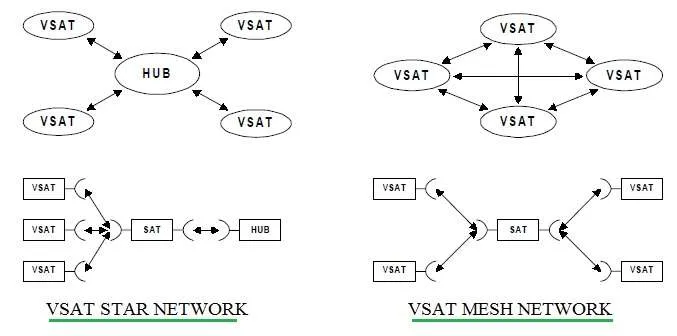
Figure 2: VSAT network architectures
VSAT can transmit various types of information, including voice, video, and data.
Benefits or Advantages of VSAT
- Installation: VSAT services can be deployed quickly, often in hours or minutes.
- Coverage: VSAT is available anywhere with a clear line of sight between the VSAT antenna and the satellite. It’s especially popular in hilly areas where other communication methods are either unavailable or difficult to install.
- Price: VSAT terminals are relatively inexpensive.
- Upgradability: Adding a VSAT site and increasing bandwidth is flexible, adapting to future requirements.
- Service Charges: These depend on the bandwidth allocated according to user needs.
- Performance: Modern VSAT systems use TCP/HTTP and other acceleration protocols to provide superior performance, despite latency limitations.
- Consistent Quality of Service: VSAT provides the same quality of service and speed across the entire network.
- Independence: VSAT services are independent of other wired and wireless transmission mediums. This makes it a great backup system during disasters and emergency situations.
- Mobility: VSAT terminals and hardware can be installed on trucks or vans for use in mobile conditions.
- No Last Mile Issues: VSAT operation doesn’t suffer from the “last mile” problem common in other communication systems.
Drawbacks or Disadvantages of VSAT
- Line of Sight Requirement: VSAT requires a clear line of sight between the VSAT dish and the satellite.
- System Failure Risk: Malfunctions in the satellite or Hub station (in Star topology) can disrupt VSAT services. Redundant systems and switch-over units are needed as backups, increasing the overall cost.
- Latency: Packet transmission latency is higher due to the satellite’s distance from Earth (approximately 36,000 km). Latency is further increased in Star topology due to the two hops required.
- Weather Sensitivity: VSAT services can be affected by bad weather conditions.
- Security Risks: Because information transmitted by VSAT travels over the air, it’s prone to intrusion by hackers. Encryption-decryption units are needed for secure communication, increasing the terminal cost.
Summary
VSAT technology provides a powerful solution for establishing connectivity in remote areas, offering high speed data, voice, and video services where terrestrial networks can’t reach. Its independence from ground infrastructure makes it invaluable for industries and regions lacking traditional communication options. However, the relatively higher cost, latency issues, and susceptibility to weather conditions are important downsides to consider.
Continue Learning VSAT Technology
- VSAT System Components & Installation Procedure
- VSAT Network Architecture & its Protocols
- VSAT Network Management System (NMS) Protocol Fields
- VSAT Based Internet System : Working operation
- VSAT Modem: Working, Testing, and Manufacturers
- C Band RF Transceiver Design For VSAT
- Orthomode Transducer (OMT) in VSAT : Key Benefits
- SCPC Vs MCPC : Key Differences
- VSAT Protocols : Aloha, Slotted Aloha, Selective Reject Aloha, DA-TDMA