
Difference between SPST, SPDT, DPST, and DPDT RF Switches
Advertisement
RF (Radio Frequency) switches are essential components in various electronic devices, used to route high-frequency signals. Choosing the right switch – SPST, SPDT, DPST, or DPDT – depends heavily on the specific application and the circuit’s complexity. Here’s a breakdown of each type:
These switches are chosen based on the complexity of the circuit and the specific switching requirements.
SPST (Single Pole Single Throw)
-
Functionality: An SPST switch features one input and one output. It’s designed to either connect or disconnect a single circuit path.
-
Operation: Think of it as a simple on/off switch. When “on,” the circuit is complete; when “off,” the circuit is broken.
-
Applications: Ideal for basic switching needs where you simply need to open or close a single path. A common example is a light switch.
SPDT (Single Pole Double Throw)
-
Functionality: An SPDT switch has one input and two outputs. It allows you to connect that single input to either of the two outputs.
-
Operation: This switch has three terminals: one common terminal and two others. The common terminal is connected to one of the other two terminals at any given time.
-
Applications: Used for switching between two different circuits or signal paths. A classic use case is selecting between two antennas.
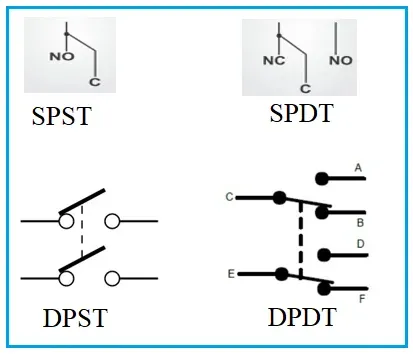
DPST (Double Pole Single Throw)
-
Functionality: A DPST switch comes with two inputs and two outputs. It’s capable of simultaneously connecting or disconnecting two separate circuits.
-
Operation: You can think of it as two SPST switches controlled by a single mechanism. When you flip the switch, both circuits are either opened or closed at the same time.
-
Applications: Perfect for switching two independent circuits on or off simultaneously. This is handy when you need to control two signal paths in sync.
DPDT (Double Pole Double Throw)
-
Functionality: A DPDT switch features two inputs and four outputs. It allows you to connect each of the two inputs to one of two output pairs.
-
Operation: This switch has six terminals: two inputs and four outputs. Each input can be routed to either of its corresponding two outputs.
-
Applications: This is the most versatile of the four. DPDT switches can be used for complex switching operations like reversing the polarity of a signal or choosing between two different sets of devices.