
What is Tunnel Diode: Advantages and Disadvantages
Advertisement
A tunnel diode is a heavily doped semiconductor diode that exhibits negative resistance due to quantum mechanical tunneling, enabling extremely fast switching and oscillation. Its advantages include ultra-high switching speed, microwave operation, and low power consumption, while its disadvantages include low output power, limited voltage range, and specialized application requirements.
Tunnel Diode : key features and Characteristics
Tunnel diodes are heavily doped p-n junction diodes exhibiting negative resistance over a portion of their characteristic curve (see Figure 1). They are also known as Esaki diodes.
These diodes are characterized by heavy doping and very thin depletion zones, specifically designed to encourage quantum mechanical tunneling currents to form.
Tunnel diodes find applications as amplifiers, oscillators, and one-shot multivibrators.
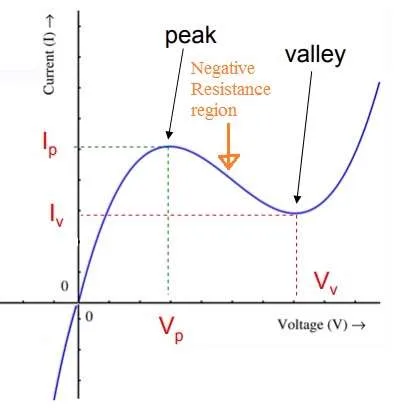 Figure 1: Tunnel diode characteristic
Compared to normal p-n junction diodes, tunnel diodes possess these distinct features:
- High Doping Levels: Doping levels on both the p-side and n-side are exceptionally high.
- Thin Depletion Zones: They feature very thin depletion zones, ranging from approximately 3 to 100 angstroms.
- Majority Carrier Tunneling: Tunneling current is primarily composed of majority carriers, specifically electrons moving from the n-side to the p-side.
- Preferred Semiconductors: Germanium (Ge) and Gallium Arsenide (GaAs) are commonly used in tunnel diode fabrication.
Benefits or Advantages of Tunnel Diodes
- High-Speed Response: The current, carried by majority carriers, in a tunnel diode responds much faster to voltage changes. This makes them useful for high-speed microwave applications.
- Low Power Consumption: They are low-power devices, efficient in their energy usage.
- Frequency Conversion: Large current flow at small reverse voltage values, due to the overlap between the conduction and valence bands, makes them suitable for frequency conversion.
- Negative Resistance: The negative resistance characteristic, as illustrated in Figure 1, is useful for reflection amplifiers and oscillators.
- Low Noise: Tunnel diodes are known for their low-noise operation.
- Simplicity and Low Cost: They are relatively simple devices to manufacture and therefore are low cost.
- Low Power Consumption: As mentioned previously, they require very little power to operate.
Drawbacks or Disadvantages of Tunnel Diodes
- Low Output Voltage Swing: They deliver a low output voltage swing compared to other types of diodes.
- Limited Power Output: Power output levels are restricted to only a few milliwatts. This is because the applied DC potential must be less than the bandgap potential of the diode.
Summary
Tunnel diodes remain valuable components for microwave oscillators, high frequency amplifiers, and ultra-fast switching circuits because of their unique negative resistance characteristics. Their high speed advantages support specialized RF applications, although limited output capability and narrow operating conditions restrict widespread use in general electronic designs.
Continue Learning Tunnel Diode
- Tunnel Diode Basics
- Resonant Tunneling Diode
- Tunnel Diode Vs. P-N Junction Diode
- Tunnel Diode Calculator