
What is Sub-6 GHz 5G: Advantages and Disadvantages
Advertisement
Sub-6 GHz 5G refers to fifth-generation mobile communication operating below 6 GHz to balance network coverage, speed, and capacity. Its advantages include wider coverage, better building penetration, and reliable mobility, while its disadvantages include lower peak data rates than millimeter-wave 5G and limited spectrum availability.
What is Sub-6 GHz 5G?
Introduction: Wireless carriers have been rolling out 5G networks since 2019, adhering to 3GPP Release 15 and later specifications.
The primary use cases for 5G technology are:
- eMBB (enhanced Mobile Broadband): Focuses on faster data rates and improved spectral efficiency.
- mMTC (massive Machine Type Communications): Designed for long battery life and high device density.
- URLLC (Ultra-Reliable Low Latency Communications): Emphasizes low latency and high reliability.
These three use cases are collectively known as the “5G Vision.”
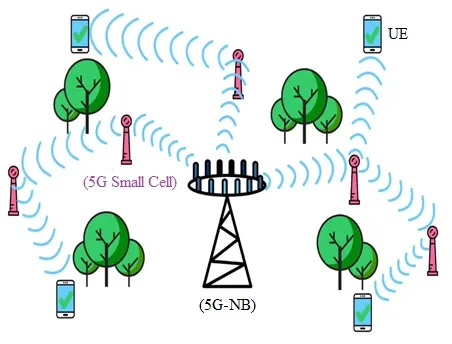 Figure: A typical 5G network consisting of a gNB (gNodeB or Base Station), 5G small cells, and 5G mobile phones.
5G networks can be deployed in two main modes:
- Non-Standalone (NSA): Operates in conjunction with an existing LTE network. LTE handles control signaling, while 5G NR manages the data transmission.
- Standalone (SA): Functions independently of LTE. Both control and data signaling are handled by the 5G system.
The 5G NR system utilizes two primary frequency ranges:
- FR2: Employs mmWave frequencies (the “high band”).
- FR1: Uses sub-6 GHz frequencies, encompassing “low band” and “mid band” frequencies.
Benefits or advantages of Sub-6 GHz 5G
- Lower Path Loss: Transmitted signals experience less path loss compared to mmWave frequencies.
- Better Penetration: Sub-6 GHz waves penetrate obstacles more effectively than mmWave, making them suitable for dense urban environments.
- Robust Signals with MIMO: Sub-6 GHz networks often employ MIMO (Multiple-Input Multiple-Output) at both transmitters and receivers. This leads to more robust signals and higher Signal-to-Noise Ratios (SNRs), resulting in faster data rates.
- Favorable Signal Reflections: Longer wavelengths in sub-6 GHz signals experience more reflections than mmWave. This can be advantageous when using MIMO, improving signal quality and coverage.
- Optimized Wireless Link via CSI: Channel State Information (CSI) helps maintain an optimized wireless link. Parameters like scattering, fading, path loss, and blocking are more predictable and repeatable within the sub-6 GHz frequency range. This provides a more favorable environment for signal propagation.
Drawbacks or disadvantages of Sub-6 GHz 5G
- Complexity and Cost: Sub-6 GHz 5G often involves multiple bands, various standards, Carrier Aggregation (CA), and dual connectivity (LTE/5G). This complexity can increase implementation costs and make the overall system more expensive.
Summary
Sub-6 GHz 5G forms the foundation of global 5G deployments by providing practical coverage, consistent performance, and broad compatibility across urban and rural environments. Its deployment advantages enable widespread adoption, although spectrum constraints limit maximum achievable throughput.