
What is Stepper Motor: Advantages and Disadvantages
Advertisement
A stepper motor is an electromechanical device that converts digital pulse signals into precise rotational movement through fixed angular steps. Its advantages include accurate position control, simple speed regulation, and repeatable motion, whereas its disadvantages include lower efficiency, resonance issues, and reduced performance at high rotational speeds.
Stepper Motor : Features, Types and Applications
A stepper motor is an electromechanical device that transforms electrical pulses into precise, discrete mechanical movements. When electrical pulses are applied in the correct sequence, the motor’s spindle rotates in distinct steps.
- The sequence of pulses determines the direction of the motor shaft’s rotation.
- The frequency of the pulses directly correlates with the speed of the shaft’s rotation.
- The number of input pulses determines the length of the rotation.
Stepper motors consist of two primary components: the stator and the rotor. The stator coils draw power at a constant level, regardless of speed.
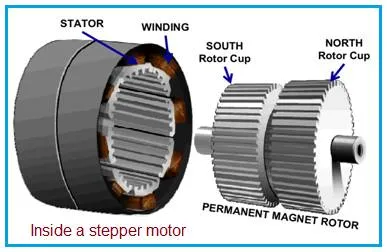
Types of Stepper Motors:
There are several types of stepper motors, including:
- Variable reluctance stepper motor
- Permanent magnet stepper motor
- Hybrid synchronous stepper motor
- Bipolar stepper motor
- Unipolar stepper motor
Applications:
Stepper motors find use in a variety of applications, such as:
- Industrial machines
- Surveillance products
- Medical scanners
- Fluid pumps
- Consumer electronics
Benefits (Advantages) of Stepper Motors
- Non-Cumulative Step Error: The percentage step error does not accumulate as the motor rotates, ensuring accuracy over long periods.
- Wide Speed Range: Stepper motors can operate at a wide range of speeds, including very slow speeds, without requiring reduction gearing.
- Excellent Responsiveness: They provide excellent response during start, stop, and reverse operations.
- High Reliability: With no brushes or commutator, stepper motors are highly reliable. Their lifespan primarily depends on the bearing’s life.
- Simple and Low-Cost Control Circuit: The control circuit for a stepper motor is relatively simple and inexpensive.
- Suitable for Low-Power Applications: They are mainly used in low power applications.
Drawbacks (Disadvantages) of Stepper Motors
- Noise and Vibration: Stepper motors can be noisy and produce vibration, which can be undesirable in certain applications.
- Resonance: Resonance can occur if the motor is not properly controlled.
- Torque Loss at High Speeds: There is a progressive loss of torque at high speeds, making it difficult to operate at extremely high speeds.
Summary
Stepper motors provide accurate motion control for automation, robotics, CNC machines, 3D printers, and positioning systems by delivering predictable incremental movement. Their control advantages simplify precision applications, although torque reduction at higher speeds and energy efficiency remain design considerations.