
What is Solid State Relay: Advantages and Disadvantages
By RF Wireless Expert Team
Advertisement
A solid state relay (SSR) is an electronic switching device that uses semiconductor components instead of mechanical contacts to control electrical loads. Its advantages include fast switching, silent operation, and long service life, while its disadvantages include higher cost, leakage current, and greater heat generation during high-power operation.
Key Features of Solid State Relay
- A solid-state relay serves as a modern alternative to the traditional electromagnetic relay.
- It’s often described as an optocoupler due to its internal design.
- An SSR consists of a light source, like an LED, and a light sensor.
- It’s commonly known by the acronym “SSR.”
- Primarily, SSRs are used to provide electrical isolation rather than just switching high current loads.
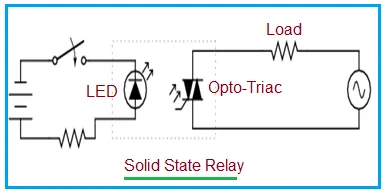
- It comes in a semiconductor package.
- It switches power ON or OFF between its output terminals based on a small current and voltage applied to its input terminals.
- These relays employ LEDs, photodiodes, SCRs, and thyristors for switching circuits ON/OFF.
- As shown above, an SSR is available in both AC and DC versions.
- It typically functions as an SPST switch, available in either normally open or normally closed configurations.
- SSRs are designed to switch currents of at least 1A.
Benefits or Advantages of Solid State Relays
- Fast Response Time: SSRs offer a very fast response, typically around 1µs ON and 0.5 µs OFF.
- Long Lifespan: They have a significantly longer lifespan compared to mechanical relays.
- Compact Size: SSRs are generally smaller in size.
- Silent Operation: Because there are no physical moving parts, solid-state relays operate silently. There’s no mechanical noise, contact bounce, resulting in a clean output signal.
- Low Power Consumption: They consume very little power due to lower current requirements (e.g., 5mA at 5VDC).
- High Durability: SSRs are highly durable and resistant to wear and tear.
- No Back EMF: The design lacks coils, which eliminates the risk of back EMF introduction into the circuit.
- Vibration Insensitivity: SSRs are less sensitive to vibration.
- High Voltage Switching: Complete internal separation between input and output allows them to switch high voltages.
- Low Voltage Operation: Some models can operate at voltages as low as 1.5V DC, unlike electromagnetic relays requiring at least 3V DC.
Drawbacks or Disadvantages of Solid State Relays
- Higher Cost: SSRs are generally more expensive than traditional electromagnetic relays.
- Current/Voltage Limitations: Their operation is bound by specific current/voltage characteristics.
- Voltage Drop: A fixed voltage drop occurs at the output due to internal impedance, which can reduce efficiency. While this is negligible for high switching voltage operation.
- Leakage Current: There is a small leakage current at the output even when the relay is in the OFF mode.
- Heat Generation: SSRs generate waste heat during the ON mode, proportional to the voltage drop.
- Sensitivity to Voltage Spikes: They can be triggered by brief voltage spikes on the input side, unlike electromagnetic relays.
- Vulnerability to Surges/Spikes: More vulnerable to surges and spikes in the current being switched on the output side, in contrast to EM relays.
Summary
Solid state relays provide reliable, maintenance-free switching for industrial automation, medical equipment, HVAC systems, and power control applications. Their operational advantages improve switching speed, durability, and electrical isolation, although thermal management, leakage current, and higher initial cost should be considered for optimal system performance.