
What is Social Distancing: Advantages and Disadvantages
Advertisement
Social distancing is a public health practice that reduces close physical contact between individuals to help limit the spread of infectious diseases. Its advantages include reduced disease transmission and protection of vulnerable populations, while its disadvantages include social isolation, economic disruption, and effects on mental well-being. This page explains social distancing in the context of COVID-19 (Coronavirus).
Social Distancing : Considerations and Suggestions
Social distancing refers to the practice of maintaining a physical distance from other people while engaging in activities such as shopping, walking, or running. This concept has gained prominence due to the COVID-19 outbreak.
COVID-19 is an infectious disease caused by a newly discovered coronavirus. This virus and the associated disease were previously unknown before emerging in Wuhan, China, in December 2019.
Coronaviruses constitute a large family of viruses capable of causing illnesses in both humans and animals. In humans, several coronaviruses lead to respiratory infections, ranging from the common cold to more severe conditions like MERS (Middle East Respiratory Syndrome) and SARS (Severe Acute Respiratory Syndrome). Common symptoms of COVID-19 include fever, fatigue, and dry cough. Some patients may also experience aches and pains, a runny nose, sore throat, shortness of breath, or diarrhea.
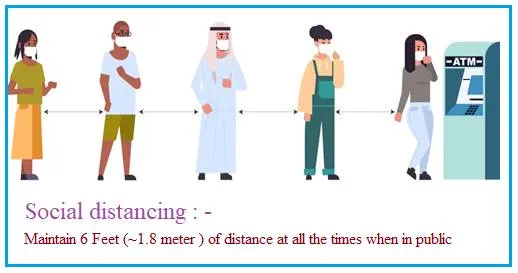
Image courtesy: The Johns Hopkins University
Social distancing aims to reduce the frequency of contact by increasing the physical space between individuals. This minimizes the risk of person-to-person or community transmission. It generally involves staying at least 6 feet away from other people, whether they are in your household or in the community.
Social distancing measures implemented to control the spread of contagious illnesses include:
- Self-isolation
- Self-quarantine
- School closures
- Workplace closures
- Cordon sanitaire (restricting entry to or exit from a defined area)
- Cancellation of mass gatherings at events, pubs, discos, theaters, clubs, religious places, musical concerts, etc.
Benefits or Advantages of Social Distancing
- Delays the Peak of Epidemic: Social distancing can delay the peak of an epidemic, giving health authorities more time to slow down transmission. It also provides time to acquire essential medical resources like forehead thermometers, infrared thermometers, FFP2 masks, FFP3 masks, face masks, surgical face masks, KN95 masks, N95 masks, protective masks, beds, and ventilators.
- Reduces Infections: It leads to a reduction in the number of people infected.
- Spreads Infections Over Time: Social distancing helps spread the number of infections over a longer period.
- Reduces Transmission Rate: It reduces the rate of disease transmission and can even stop an outbreak.
- Effective for Droplet Transmission: Social distancing is most effective when an infection spreads through droplet contact, such as coughing or sneezing.
Drawbacks or Disadvantages of Social Distancing
- Less Effective for Other Transmission Methods: It’s less effective when an infection primarily spreads through contaminated water or food, or by mosquitoes or insects.
- Can Cause Loneliness and Depression: Social distancing can lead to loneliness and depression, especially for individuals accustomed to frequent human interaction.
- Reduces Productivity: It can reduce productivity and negatively impact the advantages that come with human interaction.
Consider using contact tracing technology (like that developed by Google and Apple) and data surveillance systems to potentially save lives.
Summary
Social distancing has proven to be an important public health measure for controlling the spread of contagious diseases and reducing pressure on healthcare systems. Its preventive advantages support community health, although social, economic, and psychological impacts highlight the need for balanced implementation strategies.