
SIW Components for 6G IoT Systems & Their Core Functions
Advertisement
SIW components form the low loss passive RF front end backbone of mmWave and sub-terahertz 6G IoT systems, linking active semiconductor transceivers (CMOS, RF-SOI, SiGe BiCMOS, GaN) to beam steerable antennas with minimal signal attenuation.
Introduction : Substrate Integrated Waveguide (SIW) is a planar waveguide technology created by placing two parallel rows of conductive metallic vias (or through silicon vias) inside a dielectric or semiconductor substrate to electrically bridge top and bottom metal planes. Electromagnetic waves primarily in the fundamental TE10 mode propagate inside the enclosed channel much as they would in a traditional hollow rectangular waveguide.
Why SIW is Critical for 6G IoT
Future 6G IoT networks are expanding into upper mid-band (FR3), millimeter wave (mmWave, 30 to 300 GHz), and sub-terahertz (sub-THz, 100 to 300 GHz+) spectrum to support terabit class data rates, Massive MIMO beamforming and Integrated Sensing and Communication (ISAC).
At such higher frequencies, traditional planar lines (such as microstrip or coplanar waveguide) suffer severe radiation and dielectric losses, degrading link budgets and draining IoT node power.
At these frequencies, conventional machined metallic waveguides offer low loss and high quality factors, but are too bulky, heavy and costly for compact IoT sensors, gateways, UAVs and Antenna in Package (AiP) modules.
SIW bridges this gap by delivering waveguide grade low insertion loss, high Q performance, strong electromagnetic shielding and higher power handling in a flat, lightweight format that can be fabricated on PCBs, LTCC or silicon wafers. To meet 6G’s tighter loss and size budgets, designers increasingly rely on enhanced SIW variants such as Half Mode SIW (HMSIW), Air Filled SIW (AFSIW), Empty SIW (ESIW), multilayer SIW, and silicon Through Silicon Via (TSV) SIW.
Popular SIW Components Tailored for 6G IoT Systems
Inside a 6G IoT RF front end, SIW forms the passive backbone connecting semiconductor transceivers (made of CMOS, SiGe BiCMOS, RF-SOI, GaN) to beam steerable antenna arrays.
1. SIW Bandpass, Multiband, and Sub-THz Filters
Filters are essential for isolating closely packed frequency channels, blocking adjacent band interference and preventing spurious emissions across shared sensing and communication bands.
Useful SIW components for 6G IoT include Silicon TSV Based & Wafer Level Packaged SIW Filters, SIW SSPP Filters and Multilayer & HMSIW Filters.
2. SIW Multiplexers and Diplexers
Because 6G IoT nodes often handle multiple bands simultaneously (such as FR3 for wide area links, mmWave for high speed data, and dedicated bands for ISAC environmental sensing), they must combine or separate signals onto shared antennas without mutual interference.
SIW diplexers and multiplexers route distinct frequency bands through resonant iris coupled cavities with low insertion loss and high isolation, reducing total antenna count and PCB space inside compact IoT terminals.
3. SIW Power Dividers and Combiners
Massive MIMO and phased array antennas require feeding dozens or hundreds of radiating elements from a single transceiver chain, or combining outputs from multiple solid state power amplifiers (SSPAs) to overcome high frequency path loss.
Multi-way SIW, AFSIW, and multilayer SIW power dividers split RF power with minimal amplitude/phase imbalance and far lower conductor/radiation loss than microstrip Wilkinson dividers at mmWave and sub-THz bands.
4. SIW Directional Couplers, Hybrids, and Passive Beamforming Matrices
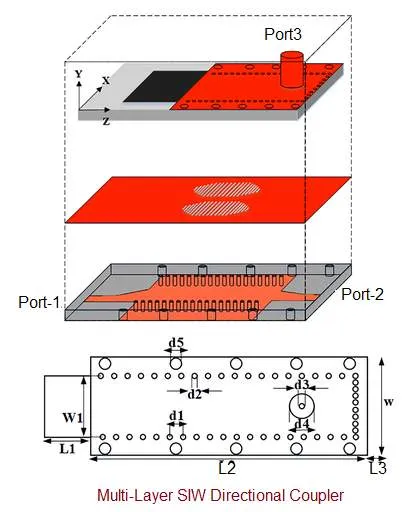 Image Courtesy : researchgate.net
Directional couplers and 90 degree/180 degree hybrids are core building blocks for balanced amplifiers, I/Q mixers, power monitoring, and switched beam networks. The figure depicts layout and structure of SIW based directional coupler.
By interconnecting SIW 90° hybrid couplers and phase shifters in a planar or multilayer stack, engineers construct compact SIW Butler Matrices and multi-beam feed networks. These enable low cost passive beamforming for dense IoT access points, smart factory nodes, and UAV relays without requiring full digital transceiver chains per antenna element.
5. SIW Phase Shifters and True Time Delay (TTD) Elements
To steer narrow mmWave and sub-THz beams dynamically toward moving IoT devices or targets, analog and hybrid beamforming networks rely on low loss phase control.
SIW phase shifters implemented via delay lines, varactor/PIN loaded cavities, or slow wave periodic structures deliver precise phase shifting with lower insertion loss than standard planar lines, helping preserve link margin and reduce PA power consumption.
6. SIW Antennas and Integrated Feed Networks
At high frequencies, running long microstrip feed lines between a filter/beamformer and an antenna patch wastes valuable RF power. Following SIW antenna types are very useful for 6G IoT applications.
- SIW Slot Antenna Arrays: Etching radiating slots directly into the top metal wall of an SIW turns the waveguide itself into a compact, high gain, low profile antenna array ideal for IoT gateways and customer premises equipment.
- HMSIW Leaky Wave Antennas: Offer frequency dependent beam scanning using a halved footprint, useful for low cost angular sensing and tracking in ISAC nodes.
- AiP / Multilayer Cavity Backed Feeds: Couple energy vertically from embedded SIW passives into Antenna in Package (AiP) radiators, cutting interconnect losses.
7. SIW Matching Networks and Planar to Waveguide Transitions
Because active ICs (LNAs, PAs, mixers) operate in microstrip or coplanar modes while low loss passives operate in SIW or air filled cavities, smooth mode conversion is vital.
Tapered microstrip to SIW, CPW to SIW, and RDL to TSV transitions provide broadband impedance matching with minimal reflection, allowing seamless integration between active RFICs and low loss passive waveguide blocks inside a single package.
Manufactures of SIW Components
The top manufacturers of SIW components used for 6G IoT include Knowles Precision Devices (Dielectric Laboratories / DLI Brand), Nuvotronics (a Cubic Defense Company), Mini-Circuits, Krytar, Gapwaves AB, MEMtronics USA, ECHO Microwave Japan, ED2 Corporation, RF MISO etc.
Summary
Together, these SIW components solve one of 6G IoT’s hardest hardware dilemmas i.e. achieving low insertion loss, sharp selectivity, and efficient directional beamforming at mmWave and sub-THz frequencies while keeping IoT devices small, power efficient and economically manufacturable at scale.
Continue Learning Substrate Integrated Waveguide (SIW)
Explore More Waveguide Components
- Waveguide Isolator
- Waveguide Gasket Types
- Waveguide Switch Types
- Waveguide Tees - E-Plane & H-Plane
- Circular Waveguide Polarizer Types
- Waveguide Components Manufacturers
- Waveguide Diplexer
- Waveguide Antennas - WR28 & WR90 Horn antennas
- Waveguide Frequency Multiplier
- Coaxial to Waveguide Adapters
- Flexible Waveguide
- Circular Waveguide Mode Suppressors
- Waveguide Bends & Flanges
- Waveguide Adapters
- Waveguide Couplers
- Waveguide Filters
- Waveguide Phase Shifting Structures
- Waveguide to Microstrip Transitions
Continue Learning Microwave Waveguide
- Waveguide Basics Tutorial: Types, Modes, Cutoff Frequency, Pros & Cons
- Rectangular vs. Circular Waveguide
- Rectangular Waveguide Dimensions chart
- TEM Waves and Waveguide Modes: A Comprehensive Overview
- What is Dominant Mode in Rectangular & Circular Waveguide
- Frequency Bands used in Waveguide
- Advantages & Disadvantages of Microwave Waveguide
- Waveguide Vs. Coaxial Line : Key Differences