
What is SDN: 5 Advantages and Disadvantages
Advertisement
Software Defined Networking (SDN) is a networking architecture that separates the control plane from the data plane to enable centralized network management and automation. Its advantages include improved flexibility and simplified configuration, while its disadvantages include controller dependency, implementation complexity, and evolving security considerations.
SDN Architecture and its elements
A Software Defined Network is a network designed to adapt to unpredictable traffic demands.
SDN effectively manages sudden spikes in resource needs while maintaining efficient resource allocation most of the time. It ensures rapid network reconfiguration by incorporating business rules, making it well suited for environments with fluctuating network loads.
This technology proves advantageous for customers experiencing day-to-day variations in network traffic, such as social networking sites (e.g., Twitter, Facebook, Yahoo). It’s also ideal for search engines like Google and Yahoo, which rely on large data centers and geographically dispersed resources with varying workloads.
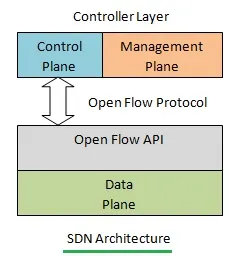
SDN uses APIs to configure as per varying need. Moreover, it has logically centralized control plane. It can be configured using open software.
Benefits or Advantages of SDN
- Centralized Management: SDN enables centralized management of networking devices.
- Automation: It helps in automating networking devices, reducing manual intervention.
- Improved User Experience: SDN provides improvements for end users, resulting in a better overall experience.
- Flexibility, Scalability, and Efficiency: Compared to traditional networking, SDN offers greater flexibility, scalability, and efficiency.
- Wide Adoption: It is widely used by social networking websites (Facebook, Twitter, Google Plus, etc.) and large database search engines (Google, Yahoo, Ask, etc.).
Drawbacks or Disadvantages of SDN
- Infrastructure Changes: Implementing SDN requires changes to the entire network infrastructure, including deploying SDN protocols and controllers. This necessitates complete reconfiguration of the network.
- Increased Costs: Reconfiguring the network increases costs associated with SDN deployment.
- Training Requirements: Staff need to be trained on the new SDN technologies.
- New Tools: New management tools need to be procured, and personnel must be trained to use them effectively.
- Security Challenges: Security poses a significant challenge in SDN environments.
- Single Point of Failure: The centralized nature of SDN can create a single point of failure, potentially disrupting the entire network.
Summary
SDN enables intelligent, programmable networks that improve automation, scalability, and resource utilization across enterprise and cloud environments. Its architectural advantages simplify network management and innovation, although controller resilience and cybersecurity remain important deployment priorities.