
What is MEO Orbit : Advantages and Disadvantages
Advertisement
Medium Earth Orbit (MEO) is a satellite orbit located between Low Earth Orbit (LEO) and Geostationary Earth Orbit (GEO), typically ranging from 2,000 km to 35,786 km. It is widely used for navigation systems such as GPS. Advantages include wider coverage and fewer satellites, while disadvantages include higher latency than LEO.
Key Features of MEO orbit
There are three main types of orbits: LEO (Low Earth Orbit), MEO, and GEO (Geostationary Orbit), categorized by their distance from the Earth, from lowest to highest. Satellites are placed into these orbits after their launch to serve various purposes.
Here are some key characteristics of MEO orbits:
- Orbit Period: 2 to 8 hours
- Orbit Height from Earth: 5,000 to 12,000 km
- Satellite Lifespan: Long
- Signal Propagation Loss: High
- Number of Satellites for Global Coverage: 8 to 20
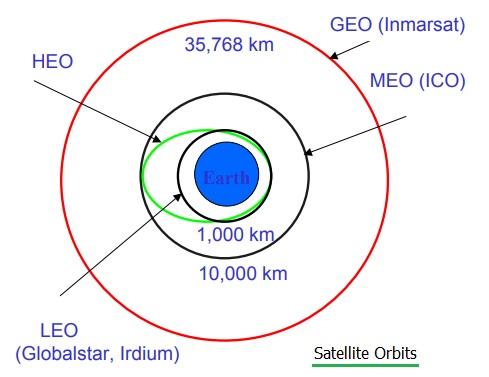
Figure 1: MEO (Medium Earth Orbit)
Advantages of MEO Orbit
Here are the benefits of using a Medium Earth Orbit:
- MEO satellites are launched at a higher altitude compared to LEO satellites. This means fewer satellites are needed to cover the entire surface of the Earth.
- MEO satellites are launched at a lower altitude compared to GEO satellites. Consequently, the time delay for signals traveling between the Earth and the satellite (and vice versa) is less (around 40 ms) compared to GEO satellites (around 120 ms).
- MEO requires slightly higher transmission power compared to LEO satellites.
- The overall system cost is cheaper compared to GEO.
Disadvantages of MEO Orbit
Here are the drawbacks of using a Medium Earth Orbit:
- Signals from MEO satellites are weaker when they reach Earth compared to LEO. This is due to the higher altitude of MEO in comparison to LEO. Therefore, more transmit power is needed to overcome path loss and atmospheric attenuation.
- A single MEO satellite is only visible for 2 to 8 hours from a particular point on Earth. This necessitates tracking the satellites from Earth due to their movement.
- The system is more expensive compared to LEO.
- Multiple MEO satellites are needed to provide continuous coverage of a region.
Summary
MEO satellites balance coverage and latency for navigation and communication services. Advantages include efficient global coverage, while disadvantages include signal delay and higher launch costs than LEO systems.
Advertisement


